## Diagram: Social Context and Object Association Network
### Overview
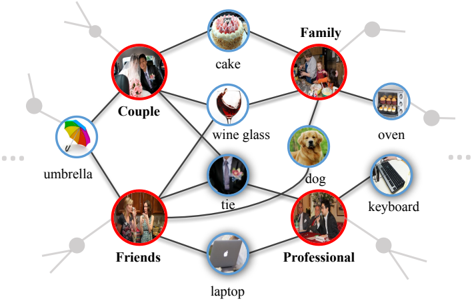
The image displays a network diagram illustrating associations between four primary social contexts (represented by red-bordered circular nodes) and eight associated objects (represented by blue-bordered circular nodes). The diagram uses a graph structure with nodes and connecting lines to show relationships. The overall layout is a symmetrical, diamond-like arrangement with social contexts at the corners and objects placed centrally and peripherally.
### Components/Axes
**Social Context Nodes (Red Borders):**
1. **Couple** (Top-Left): Contains an image of a man and woman in formal attire.
2. **Family** (Top-Right): Contains an image of a family group (appears to be two adults and a child).
3. **Friends** (Bottom-Left): Contains an image of a group of four smiling people.
4. **Professional** (Bottom-Right): Contains an image of a person in a suit, possibly in an office setting.
**Object Nodes (Blue Borders):**
1. **umbrella** (Far Left): Contains an image of a colorful, open umbrella.
2. **cake** (Top Center): Contains an image of a decorated cake with lit candles.
3. **wine glass** (Center): Contains an image of a glass of red wine.
4. **dog** (Center-Right): Contains an image of a golden retriever-type dog.
5. **oven** (Far Right, upper): Contains an image of a built-in kitchen oven.
6. **keyboard** (Far Right, lower): Contains an image of a computer keyboard.
7. **laptop** (Bottom Center): Contains an image of an open laptop computer.
8. **tie** (Center, below wine glass): Contains an image of a patterned necktie.
**Connections (Black Lines):**
The lines represent associations. Each social context node is connected to four object nodes.
* **Couple** is connected to: umbrella, cake, wine glass, tie.
* **Family** is connected to: cake, wine glass, dog, oven.
* **Friends** is connected to: umbrella, wine glass, tie, laptop.
* **Professional** is connected to: tie, dog, keyboard, laptop.
**Spatial Layout:**
* The four social context nodes form the corners of a diamond.
* The `wine glass` and `tie` objects are positioned centrally, acting as hubs connected to multiple contexts.
* The `umbrella` and `laptop` objects are positioned on the left and bottom central axes, respectively.
* The `cake`, `dog`, `oven`, and `keyboard` objects are positioned along the top, right, and bottom-right areas.
### Detailed Analysis
The diagram explicitly maps which objects are linked to which social scenario. The connections are non-exclusive; several objects are shared across multiple contexts.
* **Shared Objects:**
* `wine glass` is connected to all four social contexts (Couple, Family, Friends, Professional).
* `tie` is connected to three contexts (Couple, Friends, Professional).
* `umbrella` is connected to two contexts (Couple, Friends).
* `dog` is connected to two contexts (Family, Professional).
* `laptop` is connected to two contexts (Friends, Professional).
* `cake` is connected to two contexts (Couple, Family).
* **Unique Objects:** `oven` is connected only to Family. `keyboard` is connected only to Professional.
### Key Observations
1. **Central Hubs:** The `wine glass` is the most connected node, serving as a universal connector across all social contexts. The `tie` is a secondary hub.
2. **Contextual Groupings:** Objects cluster around related contexts. For example, `cake` and `wine glass` link the celebratory/social contexts of Couple and Family. `laptop` and `keyboard` link the more modern/work-oriented contexts of Friends and Professional.
3. **Symmetry and Balance:** The diagram is visually balanced, with each social context having exactly four object connections, suggesting an intentional design to show equal relational complexity.
4. **Implied Themes:** The objects suggest common activities or items associated with each social setting: celebration (cake, wine), work (laptop, keyboard, tie), home life (oven, dog), and leisure/outing (umbrella).
### Interpretation
This diagram is a conceptual model, likely from a study in social psychology, marketing, or human-computer interaction, illustrating how different social scenarios prime or activate associations with specific objects. It demonstrates that object perception is context-dependent.
* **What it Suggests:** The data suggests that our mental representation of objects is linked to social frameworks. A `wine glass` isn't just a vessel; it's mentally tied to romantic, familial, friendly, and professional gatherings. A `tie` is strongly linked to both formal professional settings and social occasions like dates or parties with friends.
* **Relationships:** The network structure shows that social contexts are not isolated but share common object associations, creating a web of interconnected concepts. The central placement of `wine glass` and `tie` highlights their role as versatile social symbols.
* **Notable Anomalies/Outliers:** The `oven` being uniquely tied to "Family" and the `keyboard` uniquely tied to "Professional" are strong, specific associations that highlight the defining activities of those contexts (cooking at home vs. office work). The connection of `dog` to both "Family" and "Professional" is interesting, possibly reflecting the dual role of pets as family members and as companions in home-office environments.
**Language Declaration:** All text in the image is in English.