## Set Theory Problem
### Overview
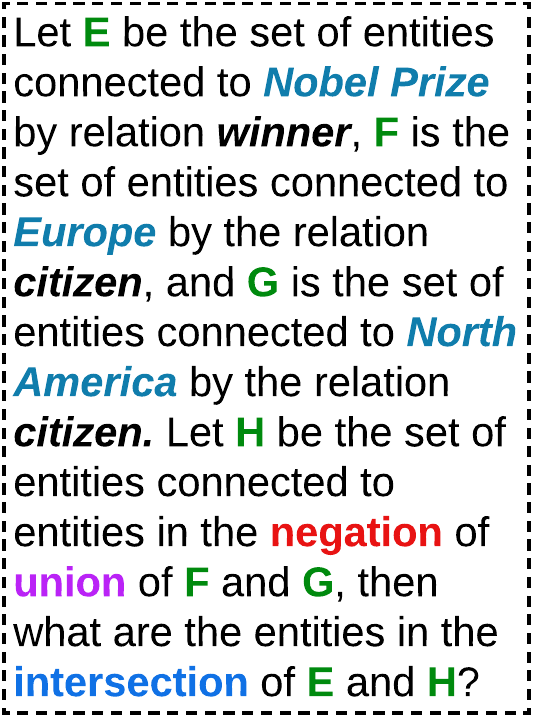
The image presents a set theory problem involving entities connected to Nobel Prize, Europe, and North America through specific relations. It defines sets E, F, G, and H based on these connections and asks for the entities in the intersection of E and H.
### Components/Axes
* **E**: Set of entities connected to Nobel Prize by relation winner (Black Text)
* **F**: Set of entities connected to Europe by the relation citizen (Black Text)
* **G**: Set of entities connected to North America by the relation citizen (Black Text)
* **H**: Set of entities connected to entities in the negation of the union of F and G (Black Text)
* **Nobel Prize**: Mentioned in Blue Text
* **Europe**: Mentioned in Green Text
* **North America**: Mentioned in Blue Text
* **negation**: Mentioned in Red Text
* **union**: Mentioned in Purple Text
* **intersection**: Mentioned in Blue Text
### Detailed Analysis or ### Content Details
The problem defines the following sets:
* **E**: Entities connected to "Nobel Prize" by the relation "winner".
* **F**: Entities connected to "Europe" by the relation "citizen".
* **G**: Entities connected to "North America" by the relation "citizen".
* **H**: Entities connected to the negation of the union of F and G. This means H contains entities connected to things that are *not* citizens of either Europe or North America.
The question asks to find the entities in the intersection of E and H (E ∩ H). This means finding the entities that are both Nobel Prize winners (E) and connected to entities that are not citizens of Europe or North America (H).
### Key Observations
* The problem involves set theory concepts like union, negation, and intersection.
* The sets are defined based on relationships between entities and specific locations or awards.
* The question requires finding the common elements between two derived sets (E and H).
### Interpretation
The problem is a theoretical exercise in set theory and relational logic. It asks us to consider the relationships between different sets of entities based on their connections to specific locations and achievements. The solution would involve identifying entities that are both Nobel Prize winners and connected to entities that are not citizens of either Europe or North America. This could potentially include individuals who have won the Nobel Prize but are citizens of other regions, or entities connected to Nobel Prize winners who are not citizens of Europe or North America.