\n
## Text Block: Set Theory Problem
### Overview
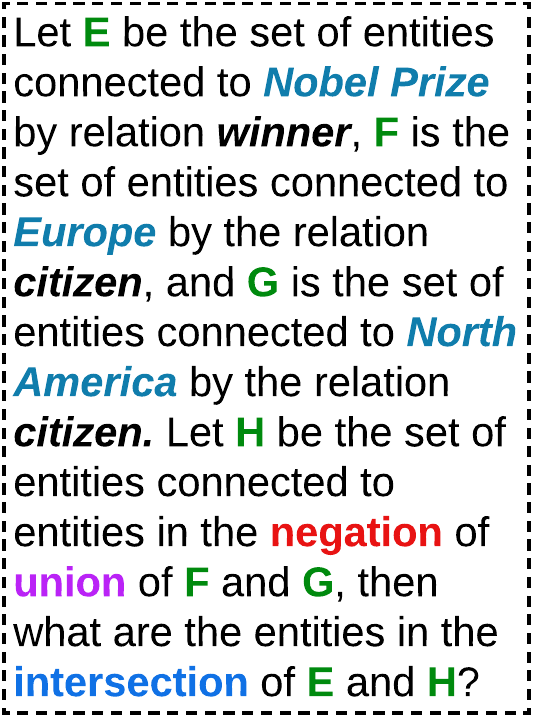
The image presents a textual description of a set theory problem, likely related to knowledge graph analysis or database querying. It defines several sets (E, F, G, H) based on relationships between entities and geographical locations, and poses a question about the intersection of two of those sets.
### Content Details
The text can be transcribed as follows:
"Let E be the set of entities connected to **Nobel Prize** by relation winner, F is the set of entities connected to **Europe** by the relation citizen, and G is the set of entities connected to **North America** by the relation citizen. Let H be the set of entities connected to entities in the **negation of union of F and G**, then what are the entities in the **intersection of E and H**?"
The following terms are highlighted in color:
* **Nobel Prize** (Purple)
* **Europe** (Blue)
* **North America** (Teal)
* **negation of union of F and G** (Green)
* **intersection of E and H** (Red)
### Key Observations
The problem is stated in a formal, mathematical notation using set theory concepts. The use of color highlights key entities and operations within the problem statement. The problem appears to be designed to test understanding of set operations (union, negation, intersection) in the context of relational data.
### Interpretation
The problem describes a scenario where entities are linked to concepts (Nobel Prize) and locations (Europe, North America) through relationships (winner, citizen). The question asks to identify entities that are Nobel Prize winners *and* are not citizens of either Europe or North America. This suggests a focus on identifying Nobel laureates from other regions of the world. The problem is likely intended to be solved using a knowledge graph or database that stores information about entities and their relationships. The use of set theory provides a formal framework for expressing the query. The problem is not presenting data, but rather a logical puzzle.