## 3D Diagram: Colored Cubes Arrangement
### Overview
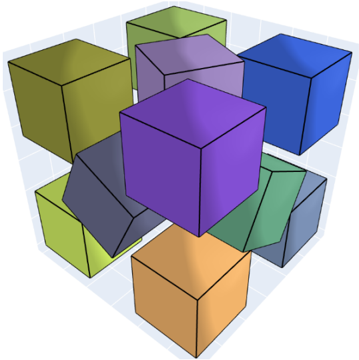
The image depicts a 3D arrangement of 10 cubes in a grid-like structure. The cubes vary in color (green, purple, blue, orange, gray, and dark green) and are positioned at different depths, creating a layered, overlapping effect. No textual labels, legends, or axis markers are visible.
### Components/Axes
- **No explicit labels, axis titles, or legends** are present.
- **Cubes** are the primary components, with no clear indication of categories, sub-categories, or data relationships.
- **Spatial arrangement**: Cubes are distributed across a 3D grid, with some cubes partially obscured by others.
### Detailed Analysis
- **Color distribution**:
- Green: 2 cubes (top-left and bottom-left).
- Purple: 2 cubes (center and top-center).
- Blue: 1 cube (top-right).
- Orange: 1 cube (bottom-center).
- Gray: 2 cubes (middle-left and bottom-right).
- Dark green: 1 cube (middle-right).
- **Positioning**:
- Cubes are arranged in a 3D grid, with some cubes overlapping others.
- No clear pattern in color-to-position mapping (e.g., no gradient or clustering by color).
### Key Observations
- **No numerical data or trends** are present. The image is purely a 3D visual representation without embedded text or data points.
- **Overlapping cubes** suggest depth, but no explicit spatial relationships (e.g., "front," "middle," "back") are labeled.
- **Color variety** implies potential categorization, but no legend or key exists to confirm this.
### Interpretation
The image appears to be a **3D diagram** designed to visualize spatial relationships or hierarchical structures. However, the absence of labels, legends, or textual context makes it impossible to extract factual data or interpret specific trends. The cubes’ colors and positions may symbolize categories or values, but without additional information, this remains speculative. The diagram could represent a conceptual model (e.g., organizational structure, data flow) but lacks the necessary annotations to confirm its purpose or meaning.
**Note**: The image contains no textual information, numerical values, or explicit data points. All descriptions are based on visual analysis of the 3D cube arrangement.