\n
## Diagram: Evaluation Goals, Metrics, and Paradigms
### Overview
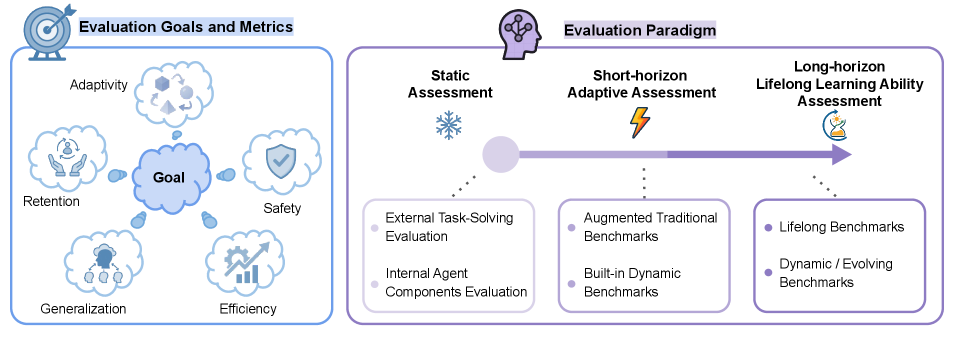
The image is a diagram illustrating the relationship between evaluation goals & metrics and evaluation paradigms in the context of lifelong learning. It presents a visual framework with two main sections: a circular representation of evaluation goals and a linear progression of evaluation paradigms. The diagram uses icons and text to convey concepts related to assessing adaptive, safe, and efficient AI systems.
### Components/Axes
The diagram is divided into two main sections:
* **Left Section: Evaluation Goals and Metrics** - This section features a central "Goal" icon surrounded by six icons representing evaluation goals: Adaptivity, Retention, Generalization, Efficiency, Safety, and Goal. Each goal is visually connected to the central "Goal" icon with curved arrows.
* **Right Section: Evaluation Paradigm** - This section depicts a horizontal timeline divided into three stages: Static Assessment, Short-horizon Adaptive Assessment, and Long-horizon Lifelong Learning Ability Assessment. Each stage is associated with specific evaluation methods.
### Detailed Analysis or Content Details
**Left Section - Evaluation Goals and Metrics:**
* **Adaptivity:** Represented by a brain icon with cloud-like elements.
* **Retention:** Represented by a brain icon.
* **Generalization:** Represented by a brain icon with a puzzle piece.
* **Efficiency:** Represented by a graph icon.
* **Safety:** Represented by a checkmark inside a shield icon.
* **Goal:** Represented by a circular target icon.
**Right Section - Evaluation Paradigm:**
* **Static Assessment:**
* Associated with "External Task-Solving Evaluation" and "Internal Agent Components Evaluation".
* Visualized with a snowflake icon.
* **Short-horizon Adaptive Assessment:**
* Associated with "Augmented Traditional Benchmarks" and "Built-in Dynamic Benchmarks".
* Visualized with a lightning bolt icon.
* **Long-horizon Lifelong Learning Ability Assessment:**
* Associated with "Lifelong Benchmarks" and "Dynamic / Evolving Benchmarks".
* Visualized with a brain icon with a sprout.
* The progression between the stages is indicated by a purple arrow with dotted lines.
### Key Observations
The diagram emphasizes a progression in evaluation methods, moving from static assessments to adaptive and ultimately lifelong learning ability assessments. The goals of adaptivity, retention, generalization, efficiency, and safety are central to all evaluation paradigms. The visual connection between the goals and paradigms suggests that these goals should be considered throughout the entire evaluation process.
### Interpretation
The diagram illustrates a framework for evaluating AI systems designed for lifelong learning. It suggests that effective evaluation requires considering not only static performance on specific tasks (Static Assessment) but also the system's ability to adapt and learn over time (Short-horizon and Long-horizon Assessments). The inclusion of goals like safety and efficiency highlights the importance of responsible AI development. The progression from left to right implies a growing complexity in evaluation methods, mirroring the increasing sophistication of lifelong learning systems. The diagram is a high-level conceptual overview and does not provide specific quantitative data or metrics. It serves as a visual guide for researchers and developers working on lifelong learning systems, emphasizing the need for a holistic and adaptive evaluation approach.