## Diagram: Evaluation Framework Architecture
### Overview
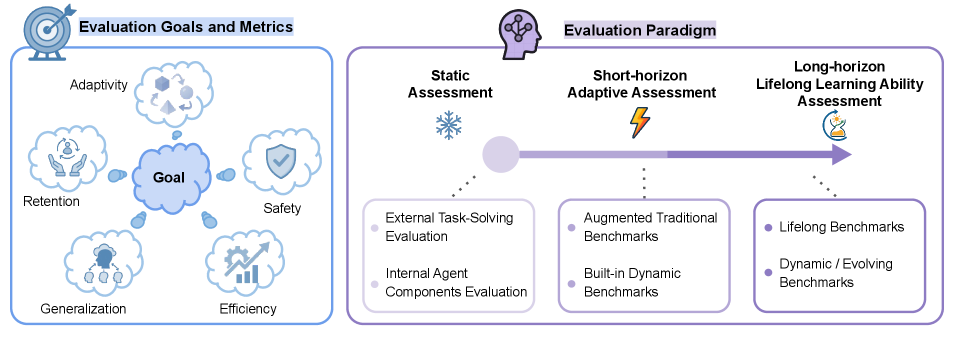
The image presents a two-part technical framework for AI system evaluation. The left section defines core evaluation goals and metrics, while the right section outlines a three-stage evaluation paradigm with progressive complexity.
### Components/Axes
**Left Diagram (Evaluation Goals and Metrics):**
- Central node labeled "Goal"
- Five radiating elements with icons:
1. **Adaptivity** (geometric shapes in motion)
2. **Retention** (hands holding a brain)
3. **Safety** (shield with checkmark)
4. **Generalization** (group of people under thought bubble)
5. **Efficiency** (graph with upward arrow)
**Right Diagram (Evaluation Paradigm):**
- Three sequential stages connected by a gradient arrow:
1. **Static Assessment** (snowflake icon)
- Sub-components:
- External Task-Solving Evaluation
- Internal Agent Components Evaluation
2. **Short-horizon Adaptive Assessment** (lightning bolt)
- Sub-components:
- Augmented Traditional Benchmarks
- Built-in Dynamic Benchmarks
3. **Long-horizon Lifelong Learning Ability Assessment** (lightbulb with circuit)
- Sub-components:
- Lifelong Benchmarks
- Dynamic/Evolving Benchmarks
### Detailed Analysis
- **Spatial Relationships:**
- Left diagram uses radial layout with "Goal" at center (coordinates: center-left)
- Right diagram employs horizontal flow from Static (left) to Long-horizon (right)
- No numerical axes present; all elements are categorical labels
- **Iconography:**
- Adaptivity: Dynamic geometric transformations
- Retention: Cognitive preservation metaphor
- Safety: Protective barrier visualization
- Generalization: Collaborative human elements
- Efficiency: Performance improvement indicator
### Key Observations
1. Evaluation goals are presented as interconnected rather than hierarchical
2. Paradigm progression shows increasing temporal complexity (static → adaptive → lifelong)
3. Each assessment stage incorporates both external and internal evaluation components
4. Long-horizon assessment emphasizes continuous adaptation through dynamic benchmarks
### Interpretation
This framework suggests a holistic approach to AI evaluation where:
- **Core Goals** (left) represent desired system characteristics rather than measurement techniques
- **Paradigm Stages** (right) demonstrate increasing evaluation sophistication:
- Static assessments provide foundational capability checks
- Short-horizon assessments introduce real-time adaptability testing
- Long-horizon assessments focus on sustained learning and evolution
- The gradient arrow between stages implies that effective evaluation requires progression through these complexity levels
- The absence of quantitative metrics suggests this is a conceptual framework rather than empirical measurement system
The diagram emphasizes that comprehensive AI evaluation must balance multiple dimensions (safety, efficiency, etc.) while progressively challenging systems across different temporal horizons.