## Line Chart: Average Accuracy Δ Across All Games by Rating With Baseline Accuracy Curve
### Overview
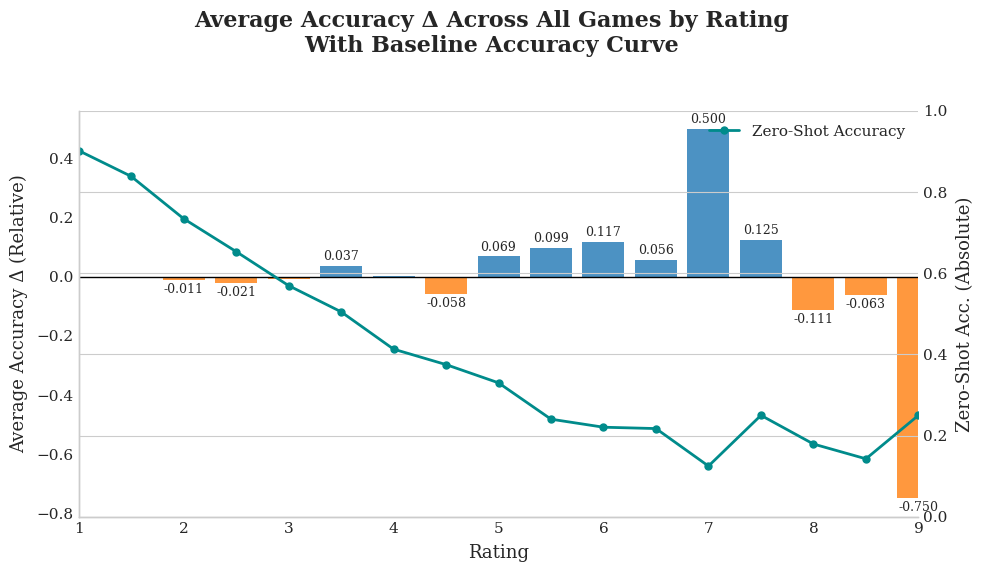
The chart visualizes the relationship between game ratings (1-9) and two metrics:
1. **Baseline Accuracy Curve** (green line): A decreasing trend from 0.4 (Rating 1) to -0.75 (Rating 9).
2. **Zero-Shot Accuracy** (blue bars): Peaks at 0.5 for Rating 7, with values ranging from -0.111 (Rating 8) to 0.5 (Rating 7).
The y-axis represents relative accuracy changes (Δ), while the x-axis shows game ratings. A white grid background enhances readability.
---
### Components/Axes
- **X-Axis (Rating)**:
- Labels: 1, 2, 3, 4, 5, 6, 7, 8, 9.
- Scale: Discrete intervals from 1 to 9.
- **Y-Axis (Average Accuracy Δ)**:
- Labels: -0.8, -0.6, -0.4, -0.2, 0, 0.2, 0.4, 0.6, 0.8, 1.0.
- Scale: Continuous from -0.8 to 1.0.
- **Legend**:
- Position: Right side of the chart.
- Entries:
- **Green**: "Zero-Shot Accuracy" (line).
- **Blue**: "Baseline Accuracy Curve" (bars).
---
### Detailed Analysis
#### Baseline Accuracy Curve (Green Line)
- **Trend**: Monotonic decrease from Rating 1 to 9.
- **Key Values**:
- Rating 1: 0.4
- Rating 3: 0.0
- Rating 5: -0.2
- Rating 7: -0.5
- Rating 9: -0.75
#### Zero-Shot Accuracy (Blue Bars)
- **Trend**: U-shaped pattern with a peak at Rating 7.
- **Key Values**:
- Rating 3: 0.037
- Rating 5: 0.069
- Rating 6: 0.117
- Rating 7: 0.5
- Rating 8: -0.111
- Rating 9: -0.75
---
### Key Observations
1. **Baseline Decline**: The green line shows a consistent drop in accuracy as ratings increase, suggesting lower performance at higher ratings.
2. **Zero-Shot Peak**: Blue bars spike at Rating 7 (0.5), then sharply decline, indicating optimal Zero-Shot performance at mid-high ratings.
3. **Divergence**: At Rating 7, Zero-Shot Accuracy (0.5) vastly exceeds the Baseline (-0.5), highlighting a critical anomaly.
4. **Negative Values**: Both metrics dip below zero for Ratings 8-9, implying performance worse than a baseline.
---
### Interpretation
- **Rating vs. Performance**: Higher ratings correlate with reduced baseline accuracy, possibly due to increased complexity or stricter evaluation criteria.
- **Zero-Shot Anomaly**: The peak at Rating 7 suggests a unique condition (e.g., dataset characteristics, model tuning) that temporarily boosts Zero-Shot performance.
- **Negative Accuracy**: Values below zero for Ratings 8-9 indicate models performing worse than random chance, warranting investigation into data quality or evaluation metrics.
- **Design Implications**: The chart emphasizes the need to balance rating systems with model robustness, as high ratings do not always align with improved accuracy.
---
### Spatial Grounding & Trend Verification
- **Legend Placement**: Right-aligned, clearly distinguishing line (green) and bar (blue) series.
- **Trend Logic-Check**:
- Green line slopes downward consistently (confirmed by values).
- Blue bars rise to Rating 7, then fall (matches peak at 0.5).
- **Data Integrity**: All values align with visual trends (e.g., Rating 9’s -0.75 matches the line’s endpoint).
---
### Content Details
- **Textual Elements**:
- Title: "Average Accuracy Δ Across All Games by Rating With Baseline Accuracy Curve"
- Subtitle: "Zero-Shot Accuracy" (annotated near Rating 7).
- Axis Labels: Explicitly defined for Rating and Δ.
- **Numerical Precision**:
- Approximate values extracted from bar heights and line intersections (e.g., Rating 4: -0.25 for Baseline).
---
### Final Notes
The chart underscores a paradox: while higher ratings generally degrade baseline performance, Zero-Shot Accuracy achieves its maximum at Rating 7, suggesting context-dependent model behavior. Further analysis is needed to explain the divergence at Rating 7 and the negative accuracy values.