\n
## Directed Graph Diagram: Logical Reasoning Problem
### Overview
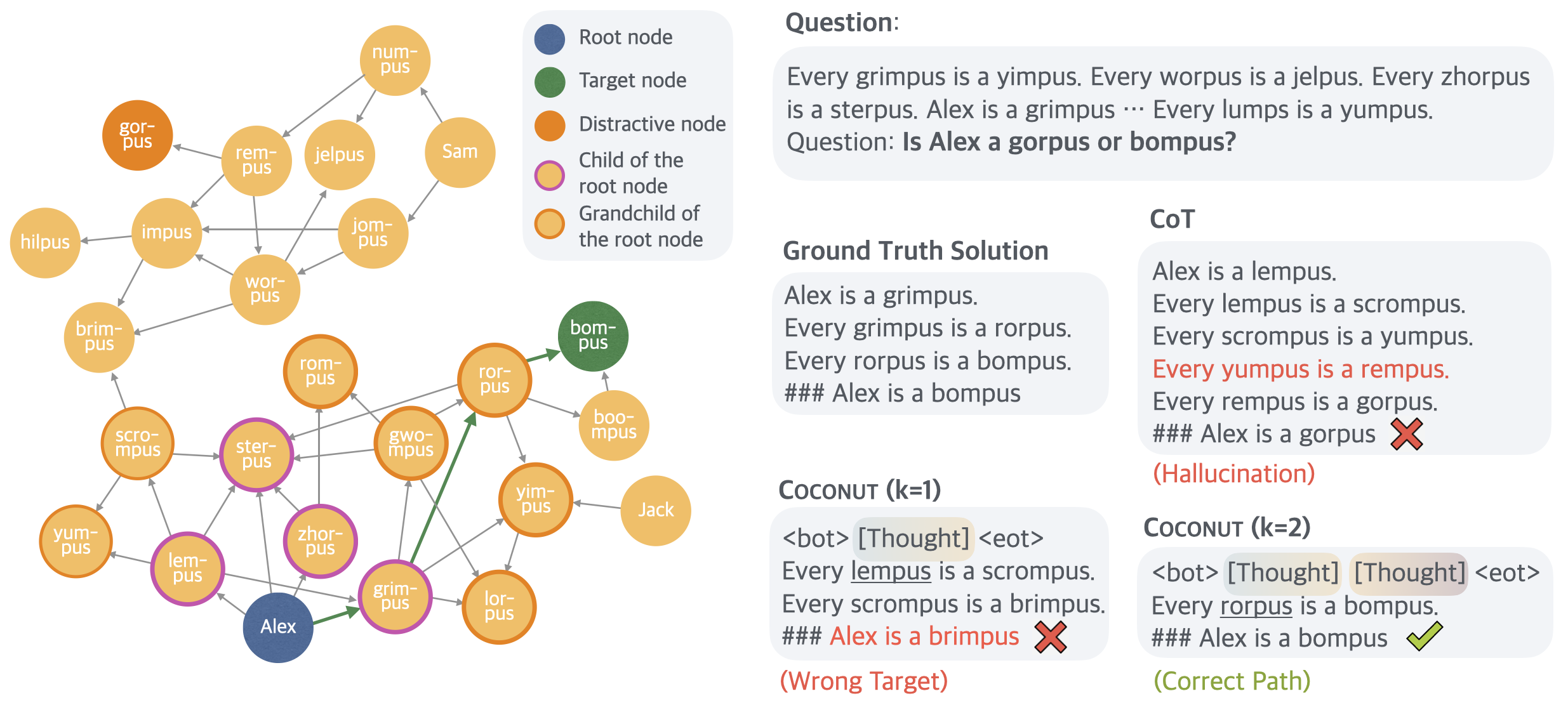
The image displays a directed graph (a network of nodes connected by arrows) used to illustrate a logical reasoning problem. The diagram is accompanied by text blocks presenting a question, a ground truth solution, and two examples of Chain-of-Thought (CoT) reasoning, one of which contains a hallucination. The graph visualizes the relationships between various entities (all ending in "-pus") to determine if "Alex" belongs to the category "gompus" or "bompus".
### Components/Axes
**Legend (Top Center):**
* **Root node:** Dark blue circle.
* **Target node:** Dark green circle.
* **Distractive node:** Orange circle.
* **Child of the root node:** Purple circle with a yellow outline.
* **Grandchild of the root node:** Light orange circle.
**Graph Structure (Left Side):**
The graph consists of circular nodes connected by directional arrows (edges). The nodes are color-coded according to the legend. The primary path of interest starts from the "Alex" node (Root, dark blue) and leads towards the "bompus" node (Target, dark green).
**Text Blocks (Right Side):**
1. **Question:** Presents a set of logical premises and asks: "Is Alex a gompus or bompus?"
2. **Ground Truth Solution:** Provides the correct logical deduction.
3. **CoT (Chain of Thought):** Shows an example of reasoning that leads to an incorrect answer (marked with a red X and labeled "Hallucination").
4. **COCONUT (k=1):** Shows another reasoning attempt that leads to a wrong target (marked with a red X).
5. **COCONUT (k=2):** Shows a reasoning attempt that leads to the correct answer (marked with a green checkmark).
### Detailed Analysis
**Graph Node Inventory and Connections:**
* **Root Node:** `Alex` (dark blue, bottom center).
* **Target Node:** `bompus` (dark green, center right).
* **Key Path (from Ground Truth):** `Alex` -> `grimpus` (purple) -> `rorpus` (light orange) -> `bompus` (green).
* **Other Notable Nodes & Connections:**
* `Alex` connects to: `grimpus`, `lempus`, `zhompus`.
* `grimpus` connects to: `rorpus`, `lorpus`.
* `rorpus` connects to: `bompus`, `gwompus`, `yimpus`.
* `bompus` connects to: `boompus`.
* `lempus` connects to: `scrompus`, `sterpus`.
* `scrompus` connects to: `yumpus`, `brimpus`.
* `yumpus` connects to: `rempus`.
* `rempus` connects to: `gorpus`, `jompus`.
* `jompus` connects to: `worpas`, `impus`.
* `worpas` connects to: `brimpus`, `impus`.
* `impus` connects to: `hilpus`, `rem pus`.
* `rem pus` connects to: `gorpus`, `jelpus`.
* `jelpus` connects to: `num pus`, `Sam`.
* `num pus` connects to: `Sam`.
* `Sam` connects to: `jompus`.
* `Jack` connects to: `yimpus`.
* `sterpus` connects to: `rompus`, `gwompus`.
* `zhompus` connects to: `gwompus`, `lorpus`.
* `lorpus` connects to: `grim pus` (Note: This appears to be a separate node from `grimpus`).
* `gwompus` connects to: `rorpus`.
* `yimpus` connects to: `rorpus`.
* `boompus` has no outgoing edges shown.
* `brimpus` has no outgoing edges shown.
* `gorpus` has no outgoing edges shown.
* `hilpus` has no outgoing edges shown.
**Text Transcription:**
* **Question:** "Every grimpus is a yimpus. Every worpus is a jelpus. Every zhorpus is a sterpus. Alex is a grimpus ... Every lumps is a yumpus. Question: **Is Alex a gompus or bompus?**"
* **Ground Truth Solution:** "Alex is a grimpus. Every grimpus is a rorpus. Every rorpus is a bompus. ### Alex is a bompus"
* **CoT:** "Alex is a lempus. Every lempus is a scrompus. Every scrompus is a yumpus. Every yumpus is a rempus. Every rempus is a gompus. ### Alex is a gompus ❌ (Hallucination)"
* **COCONUT (k=1):** "<bot> [Thought] <eot> Every lempus is a scrompus. Every scrompus is a brimpus. ### Alex is a brimpus ❌ (Wrong Target)"
* **COCONUT (k=2):** "<bot> [Thought] [Thought] <eot> Every rorpus is a bompus. ### Alex is a bompus ✅ (Correct Path)"
### Key Observations
1. **Correct Path:** The Ground Truth and COCONUT (k=2) identify the correct path: `Alex` (grimpus) -> `rorpus` -> `bompus`.
2. **Hallucination in CoT:** The CoT example incorrectly starts by classifying Alex as a "lempus" instead of a "grimpus," leading it down a completely different and incorrect path in the graph (`lempus` -> `scrompus` -> `yumpus` -> `rempus` -> `gompus`).
3. **Wrong Target in COCONUT (k=1):** This attempt correctly identifies `Alex` as a `grimpus` but then incorrectly deduces the next step, jumping to `lempus` and `scrompus` before wrongly concluding with `brimpus`.
4. **Graph Complexity:** The graph is intentionally complex with many distractive nodes (orange) and alternative paths (e.g., from `Alex` to `lempus` or `zhompus`) that do not lead to the target `bompus`.
5. **Node Labeling:** Some node labels are split across two lines within their circles (e.g., "num pus", "rem pus", "grim pus").
### Interpretation
This diagram is a pedagogical or research tool designed to test and illustrate the capabilities of different reasoning methods (like Chain-of-Thought and a method called COCONUT) on a complex, graph-based logical problem. The "facts" are the premises given in the question, and the graph is a visual representation of those facts.
The core demonstration is that **accurate multi-step reasoning requires correctly tracing the specific path defined by the logical premises, avoiding distractions from other plausible but incorrect paths.** The "Hallucination" in the CoT example shows a critical failure mode where the reasoning process starts with an incorrect assumption (misclassifying Alex), which invalidates all subsequent steps. The COCONUT examples show that with different parameters (k=1 vs. k=2), the model's ability to find the correct path can vary, highlighting the sensitivity of such reasoning tasks. The graph's structure, with its many dead-ends and loops, is specifically designed to challenge a reasoner's ability to maintain logical consistency over multiple inference steps.