## Screenshot: MathVision Data Example
### Overview
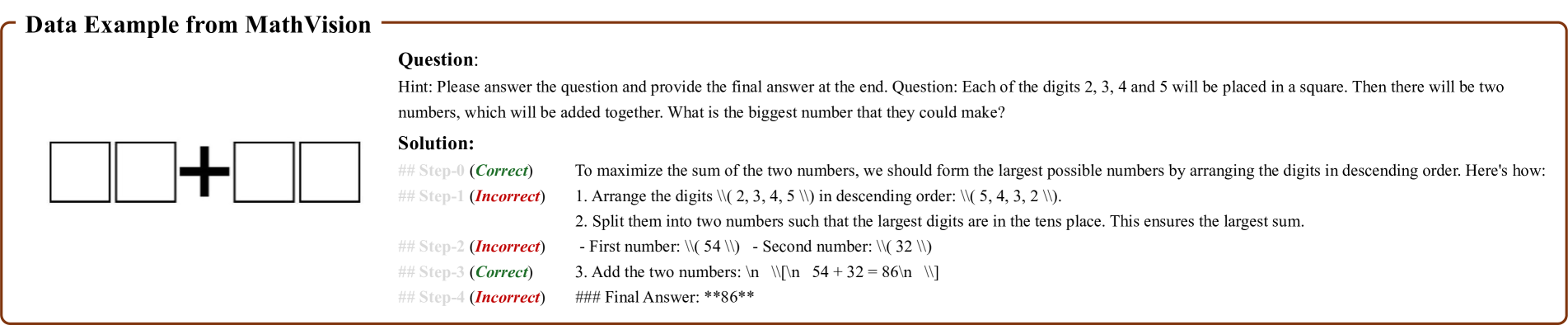
The image displays a math problem from MathVision, focusing on digit arrangement to maximize the sum of two numbers. The problem involves placing digits 2, 3, 4, and 5 into squares, forming two numbers, and determining the largest possible sum. The solution includes step-by-step reasoning with correctness annotations.
### Components/Axes
- **Title**: "Data Example from MathVision" (top-left, bold).
- **Question Section**:
- Text: "Question: Hint: Please answer the question and provide the final answer at the end. Question: Each of the digits 2, 3, 4 and 5 will be placed in a square. Then there will be two numbers, which will be added together. What is the biggest number that they could make?"
- **Solution Section**:
- Steps labeled with `# Step-X (Correct/Incorrect)`:
- `# Step-0 (Correct)`: "To maximize the sum of the two numbers, we should form the largest possible numbers by arranging the digits in descending order."
- `# Step-1 (Incorrect)`: "1. Arrange the digits (2, 3, 4, 5) in descending order: (5, 4, 3, 2)."
- `# Step-2 (Incorrect)`: "2. Split them into two numbers such that the largest digits are in the tens place. This ensures the largest sum."
- Subtext: "- First number: 54"
- Subtext: "- Second number: 32"
- `# Step-3 (Correct)`: "3. Add the two numbers: 54 + 32 = 86"
- `# Step-4 (Incorrect)`: "Final Answer: **86**"
- **Visual Elements**:
- Four empty squares (two on the left, two on the right) with a "+" symbol between them.
- Formatting: Bold text for the final answer, red/green annotations for correctness.
### Content Details
- **Digits**: 2, 3, 4, 5 (explicitly listed in the question).
- **Steps**:
- Step 0: Correct reasoning about descending order.
- Step 1: Incorrectly formatted backslashes (likely a typo or formatting error).
- Step 2: Incorrect logic about splitting digits (though the numbers 54 and 32 are correct).
- Step 3: Correct addition of 54 + 32 = 86.
- Step 4: Incorrect final answer formatting (extra `#` symbols).
- **Final Answer**: **86** (highlighted with asterisks).
### Key Observations
- The problem emphasizes arranging digits in descending order to maximize the sum.
- Step 1 and Step 2 contain formatting errors (backslashes) and logical inaccuracies, respectively.
- The correct sum (86) is derived from splitting the digits into 54 and 32.
- Step 4’s formatting error suggests a possible oversight in the solution’s presentation.
### Interpretation
The problem demonstrates a strategy for maximizing the sum of two numbers by prioritizing larger digits in higher place values. While the final answer (86) is correct, the solution steps contain inconsistencies:
1. **Formatting Issues**: Backslashes in Step 1 and extra `#` symbols in Step 4 indicate potential errors in the solution’s markup.
2. **Logical Flaw**: Step 2’s reasoning about "largest digits in the tens place" is redundant, as splitting into 54 and 32 already achieves this.
3. **Correctness**: Despite errors, the core logic (descending order and optimal splitting) leads to the correct sum.
This example highlights the importance of precise formatting and clear reasoning in algorithmic problem-solving. The final answer aligns with the mathematical principle of maximizing digit placement, even though the solution’s presentation has minor flaws.