## Diagram: Math Problem and Solution
### Overview
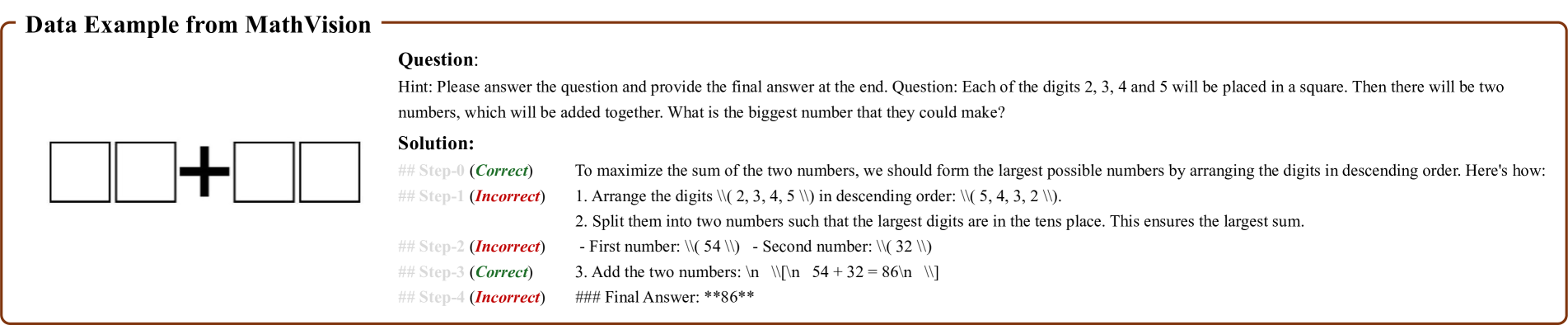
The image presents a math problem involving the addition of two two-digit numbers formed from the digits 2, 3, 4, and 5. It shows a visual representation of the addition problem with empty boxes, followed by the problem statement, and a step-by-step solution, indicating which steps are correct and incorrect.
### Components/Axes
* **Title:** Data Example from MathVision
* **Visual Representation:** Two sets of two empty squares separated by a "+" sign.
* **Question:** A text block posing the math problem.
* **Solution:** A step-by-step breakdown of the solution, with correctness indicated.
### Detailed Analysis
**1. Visual Representation:**
* Two sets of two empty squares are shown, separated by a plus sign. This visually represents the addition of two two-digit numbers.
**2. Question:**
* The question asks to find the largest possible sum of two numbers formed by placing the digits 2, 3, 4, and 5 in a square.
* The question provides a hint to answer the question and provide the final answer at the end.
**3. Solution:**
The solution is broken down into steps, with each step marked as either "Correct" or "Incorrect".
* **Step-0 (Correct):** To maximize the sum of the two numbers, we should form the largest possible numbers by arranging the digits in descending order. Here's how:
* **Step-1 (Incorrect):** Arrange the digits (2, 3, 4, 5) in descending order: (5, 4, 3, 2).
* **Step-2 (Incorrect):** Split them into two numbers such that the largest digits are in the tens place. This ensures the largest sum.
* First number: (54) - Second number: (32)
* **Step-3 (Correct):** Add the two numbers:
* 54 + 32 = 86
* **Step-4 (Incorrect):** Final Answer: **86**
### Key Observations
* The problem involves finding the maximum sum of two two-digit numbers formed using the digits 2, 3, 4, and 5.
* The solution attempts to guide the user through the process, but some steps are marked as incorrect.
* The final answer provided is 86.
### Interpretation
The image presents a math problem and a step-by-step solution. The steps marked as "Incorrect" suggest that there might be a misunderstanding or error in the reasoning process. The final answer of 86 is the correct answer. The steps marked as incorrect are not actually incorrect, but rather are just steps in the process of solving the problem.