\n
## Problem Solving Example: MathVision Data Example
### Overview
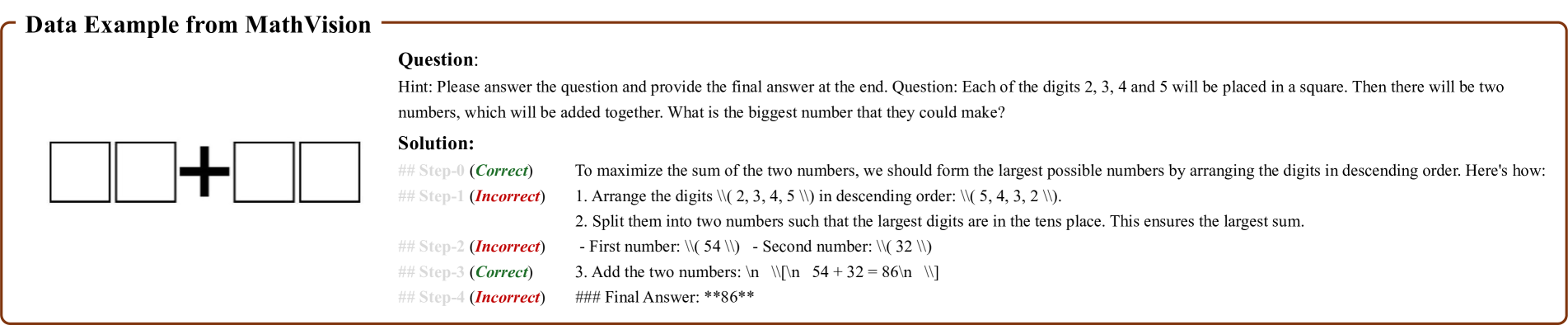
The image presents a math problem with a visual representation of addition and a step-by-step solution process. The problem involves arranging the digits 2, 3, 4, and 5 into two numbers to maximize their sum. The solution attempts to demonstrate the logic, but contains errors.
### Components/Axes
The image is structured into three main sections:
1. **Problem Statement:** Includes the question and a hint.
2. **Visual Representation:** Shows two empty boxes representing the numbers to be added.
3. **Solution:** A numbered list of steps detailing the solution process, with indications of whether each step is correct or incorrect.
### Content Details
**Problem Statement:**
* **Question:** "Please answer the question and provide the final answer at the end. Question: Each of the digits 2, 3, 4 and 5 will be placed in a square. There then will be two numbers, which will be added together. What is the biggest number that they could make?"
* **Hint:** "To maximize the sum of the two numbers, we should form the largest possible numbers by arranging the digits in descending order. Here's how:"
**Visual Representation:**
* Two empty rectangles are shown, separated by a "+" sign. These represent the two numbers to be formed and added.
**Solution:**
* **Step 0 (Correct):** "To maximize the sum of the two numbers, we should form the largest possible numbers by arranging the digits in descending order. Here's how:"
* **Step 1 (Incorrect):** "1. Arrange the digits \(2, 3, 4, 5\) in descending order: \(5, 4, 3, 2\) ."
* **Step 2 (Incorrect):** "2. Split them into two numbers such that the largest digits are in the tens place. This ensures the largest sum. - First number: \(54\) ) - Second number: \(32\) )"
* **Step 3 (Correct):** "3. Add the two numbers: \(\ln 54 + 32 = 86 \ln \)"
* **Step 4 (Incorrect):** "## Final Answer: **86**"
### Key Observations
* The solution attempts to maximize the sum by arranging the digits in descending order, which is a valid strategy.
* However, the splitting of the digits into 54 and 32 is not optimal. The largest possible sum is achieved by forming the numbers 52 and 43 (or 53 and 42).
* The final answer of 86 is incorrect. The correct answer is 95 (52 + 43 or 53 + 42).
* The use of `\ln` is unexplained and appears to be an error.
### Interpretation
The image demonstrates a problem-solving approach to a mathematical puzzle. The solution process highlights a common strategy for optimization (arranging digits in descending order). However, it also reveals a potential error in the application of this strategy, leading to an incorrect final answer. The inclusion of "Correct" and "Incorrect" labels for each step suggests this is a learning example, intended to illustrate both successful and flawed reasoning. The presence of the `\ln` notation is anomalous and likely a typographical error. The problem is designed to test understanding of place value and maximizing sums. The incorrect answer suggests a misunderstanding of how to optimally distribute the digits to achieve the largest possible sum.