\n
## Diagram: LLM Application Categories
### Overview
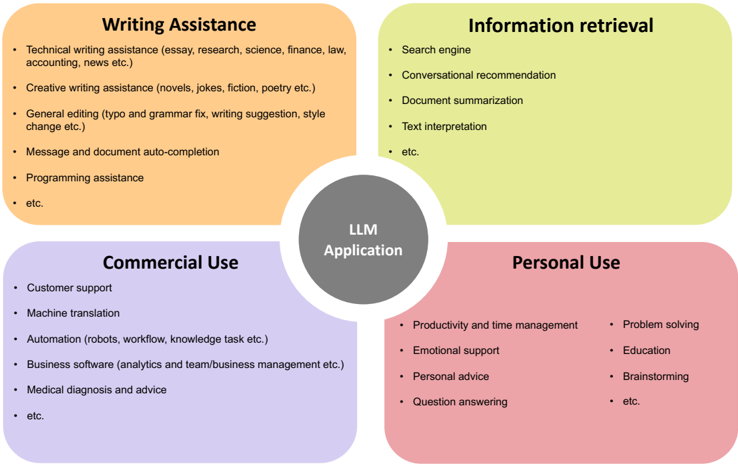
The image is a conceptual diagram illustrating the broad application domains of Large Language Models (LLMs). It features a central hub labeled "LLM Application" connected to four distinct, color-coded categories, each containing a list of specific use cases. The diagram is designed to show the versatility and wide-ranging utility of LLM technology across different sectors of human activity.
### Components/Axes
The diagram consists of five primary components:
1. **Central Hub:** A grey circle at the center labeled **"LLM Application"**.
2. **Four Category Boxes:** Rounded rectangles, each a different color, positioned around the central hub and connected to it by a white, curved pathway.
* **Top-Left (Orange):** "Writing Assistance"
* **Top-Right (Light Green):** "Information retrieval"
* **Bottom-Left (Light Purple):** "Commercial Use"
* **Bottom-Right (Light Pink):** "Personal Use"
### Detailed Analysis
Each category box contains a bulleted list of specific applications. The text within each box is transcribed below.
**1. Writing Assistance (Orange Box, Top-Left)**
* Technical writing assistance (essay, research, science, finance, law, accounting, news etc.)
* Creative writing assistance (novels, jokes, fiction, poetry etc.)
* General editing (typo and grammar fix, writing suggestion, style change etc.)
* Message and document auto-completion
* Programming assistance
* etc.
**2. Information retrieval (Light Green Box, Top-Right)**
* Search engine
* Conversational recommendation
* Document summarization
* Text interpretation
* etc.
**3. Commercial Use (Light Purple Box, Bottom-Left)**
* Customer support
* Machine translation
* Automation (robots, workflow, knowledge task etc.)
* Business software (analytics and team/business management etc.)
* Medical diagnosis and advice
* etc.
**4. Personal Use (Light Pink Box, Bottom-Right)**
This box is split into two columns of bullet points.
* **Left Column:**
* Productivity and time management
* Emotional support
* Personal advice
* Question answering
* **Right Column:**
* Problem solving
* Education
* Brainstorming
* etc.
### Key Observations
* **Categorization Logic:** The diagram groups applications by their primary context of use: professional/creative tasks (Writing), knowledge tasks (Information retrieval), business/enterprise tasks (Commercial), and individual daily life tasks (Personal).
* **Comprehensiveness:** The lists are extensive but non-exhaustive, as indicated by the "etc." at the end of each category. This suggests the listed items are representative examples rather than a complete catalog.
* **Overlap Potential:** Some applications could logically fit into multiple categories (e.g., "Machine translation" could be for personal or commercial use; "Education" could involve writing assistance). The diagram presents them in a primary, simplified grouping.
* **Spatial Layout:** The central positioning of "LLM Application" visually reinforces that all these diverse use cases stem from the same core technology. The four categories are given equal visual weight, suggesting they are all significant domains of application.
### Interpretation
This diagram serves as a high-level taxonomy, mapping the functional landscape of LLMs. It argues that the technology's value is not confined to a single niche but is a general-purpose tool with transformative potential across the spectrum of knowledge work, creative endeavor, business operations, and personal life.
The inclusion of "Medical diagnosis and advice" under "Commercial Use" and "Emotional support" under "Personal Use" highlights the move of LLMs into sensitive, high-stakes, and deeply human domains, raising implicit questions about reliability, ethics, and the nature of human-AI interaction. The "etc." in every category is crucial—it signals that this map is incomplete and that the frontier of LLM applications is still expanding. The diagram effectively communicates that to understand LLMs, one must look not at a single function, but at a constellation of capabilities being deployed in virtually every sector where language and information are central.