\n
## Diagram: LLM-Based Bug Fixing and Test Case Generation Workflow
### Overview
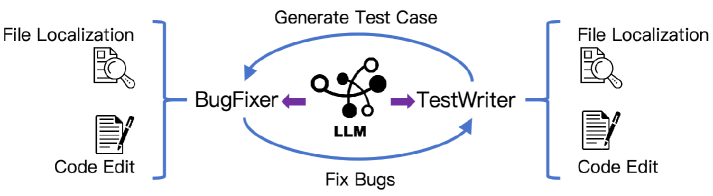
The image depicts a diagram illustrating a workflow for bug fixing and test case generation using a Large Language Model (LLM). The workflow involves two primary components: a BugFixer and a TestWriter, both powered by the LLM. The process is cyclical, with bug fixing leading to test case generation and vice versa, facilitated by file localization and code editing steps.
### Components/Axes
The diagram consists of the following components:
* **LLM:** Central component, represented as a stylized brain graphic.
* **BugFixer:** A component connected to the LLM, responsible for fixing bugs.
* **TestWriter:** A component connected to the LLM, responsible for generating test cases.
* **File Localization:** Represented by a magnifying glass over a file folder, appearing on both the left and right sides of the diagram.
* **Code Edit:** Represented by a document with a pencil, appearing on both the left and right sides of the diagram.
* **Arrows:** Curved arrows indicate the flow of the process.
* **Text Labels:** "Generate Test Case", "Fix Bugs" are labels associated with the arrows.
### Detailed Analysis or Content Details
The diagram shows a cyclical process:
1. **File Localization & Code Edit** (Left Side): This initiates the process, presumably by identifying the location of a bug and the relevant code.
2. **BugFixer -> LLM:** The BugFixer component sends information to the LLM to fix the identified bug.
3. **LLM -> TestWriter:** The LLM then passes the information to the TestWriter component.
4. **TestWriter -> Generate Test Case:** The TestWriter generates a test case to verify the bug fix.
5. **Generate Test Case -> File Localization & Code Edit** (Right Side): The generated test case is used for file localization and code editing.
6. **File Localization & Code Edit -> Fix Bugs:** The process then loops back to fixing bugs, potentially identifying new issues revealed by the test case.
The arrows indicate the following actions:
* The arrow from BugFixer to TestWriter is labeled "Generate Test Case".
* The arrow from TestWriter back to BugFixer is labeled "Fix Bugs".
### Key Observations
The diagram emphasizes the iterative nature of bug fixing and test case generation. The LLM acts as a central intelligence, coordinating both processes. The inclusion of "File Localization" and "Code Edit" suggests that the workflow is integrated with a code repository or development environment. The cyclical nature implies continuous improvement and refinement of both the code and the test suite.
### Interpretation
This diagram illustrates a modern software development workflow leveraging the capabilities of Large Language Models. The LLM is not simply a tool for code generation but a central component that orchestrates the entire process of identifying, fixing, and verifying software defects. The cyclical nature of the workflow suggests a commitment to continuous testing and improvement. The diagram highlights the potential for LLMs to automate and accelerate the software development lifecycle, reducing the time and effort required for bug fixing and quality assurance. The diagram does not provide any quantitative data or specific details about the LLM's architecture or performance. It is a conceptual representation of a workflow.