\n
## Diagram: Tree-like Structure
### Overview
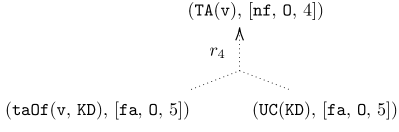
The image depicts a tree-like diagram representing a branching structure with labeled nodes. The diagram appears to represent a hierarchical relationship between different elements, possibly in a formal system or logic.
### Components/Axes
The diagram consists of nodes connected by branches. Each node contains a label enclosed in parentheses, followed by a bracketed list of values. The branches are labeled with "r4".
### Detailed Analysis or Content Details
The diagram has three nodes:
* **Top Node:** (TA(v), [nf, 0, 4])
* **Left Node:** (taUf(v, KD), [fa, 0, 5])
* **Right Node:** (UC(KD), [fa, 0, 5])
The top node is connected to the left and right nodes via branches labeled "r4".
### Key Observations
The left and right nodes share the same bracketed values: [fa, 0, 5]. The top node has different values: [nf, 0, 4]. The labels within the parentheses appear to be function or operator names with arguments.
### Interpretation
This diagram likely represents a derivation or transformation process within a formal system. The nodes represent states or expressions, and the branches represent the application of a rule or operation (r4). The bracketed values could represent properties or attributes of each state. The shared values in the left and right nodes suggest a common outcome or property resulting from the application of the rule. The differing value in the top node indicates a unique characteristic of the initial state. Without further context, it's difficult to determine the specific meaning of the labels and values, but the structure suggests a logical or computational process.