\n
## Diagram: Formal System State Transition Tree
### Overview
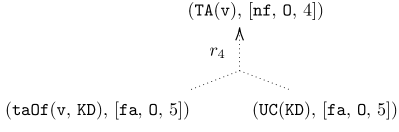
The image displays a simple tree diagram with three nodes connected by dotted lines, representing a hierarchical or relational structure in a formal system. The diagram uses mathematical notation to define entities, their parameters, and associated state vectors. A labeled transition rule connects two of the nodes.
### Components/Axes
The diagram consists of three textual nodes and one labeled connection line. There are no traditional chart axes, legends, or scales.
**Node Positions & Content:**
1. **Top Node (Centered at the top):** `(TA(v), [nf, 0, 4])`
2. **Bottom-Left Node:** `(taOf(v, KD), [fa, 0, 5])`
3. **Bottom-Right Node:** `(UC(KD), [fa, 0, 5])`
**Connection:**
* A dotted line connects the **Bottom-Left Node** to the **Top Node**.
* This line is labeled with the symbol `r₄` (r with a subscript 4), placed near its midpoint.
* A second dotted line connects the **Bottom-Right Node** to the **Top Node**, but this line has no label.
### Detailed Analysis
**Node Structure:**
Each node follows the pattern: `(Entity, [State Vector])`.
* **Entity:** Appears to be a function or constructor applied to parameters.
* `TA(v)`: Function `TA` applied to variable `v`.
* `taOf(v, KD)`: Function `taOf` applied to variable `v` and parameter `KD`.
* `UC(KD)`: Function `UC` applied to parameter `KD`.
* **State Vector:** A list of three elements within square brackets.
* **First Element:** A symbolic state identifier.
* Top Node: `nf`
* Bottom-Left Node: `fa`
* Bottom-Right Node: `fa`
* **Second Element:** A numerical value, `0` in all three nodes.
* **Third Element:** A numerical value.
* Top Node: `4`
* Bottom-Left Node: `5`
* Bottom-Right Node: `5`
**Relationships:**
* The diagram implies a parent-child or derivation relationship, with the Top Node as the parent.
* The labeled transition `r₄` specifically connects the `taOf(v, KD)` entity to the `TA(v)` entity.
* The `UC(KD)` entity is also connected to `TA(v)` but via an unlabeled transition, suggesting a different or implicit relationship.
### Key Observations
1. **State Differentiation:** The primary difference between the parent node and the child nodes is the first element of the state vector: `nf` (parent) vs. `fa` (both children).
2. **Numerical Consistency:** The second element of the state vector is constant (`0`). The third element is consistent between the two child nodes (`5`) but differs from the parent (`4`).
3. **Symmetry in Children:** The two bottom nodes, while representing different entities (`taOf` vs. `UC`), share identical state vectors (`[fa, 0, 5]`).
4. **Specific vs. General Link:** The labeled link `r₄` suggests a defined rule or operation transforms `taOf(v, KD)` into `TA(v)`. The unlabeled link from `UC(KD)` may represent a more general or different type of connection.
### Interpretation
This diagram likely models states and transitions within a formal verification, type theory, or program analysis context. The notation is characteristic of such fields.
* **What the data suggests:** The system models a property `TA(v)` (perhaps "Type Assignment" or "Trace Assertion" for value `v`) which has a state `nf` ("no fault" or "normal form") and a metric of `4`. This property can be derived from two different sources:
1. A function `taOf(v, KD)` (perhaps "type assignment of v given Knowledge/Context KD") which is in a state `fa` ("fault" or "failed assertion") with a metric of `5`. The transition `r₄` is the specific rule that resolves this to the parent state.
2. A function `UC(KD)` (perhaps "Underlying Context" or "Uninterpreted Constructor" for KD) which is also in state `fa` with metric `5`, but connects to the parent via a different, unspecified mechanism.
* **How elements relate:** The tree shows that the state `TA(v), [nf, 0, 4]` can be reached from two distinct faulty states (`fa`). The identical state vectors of the children imply that, despite their different origins, they present the same external "fault" profile to the parent node. The labeled rule `r₄` is the critical piece of logic that formally bridges one of these faulty states to the correct state.
* **Notable patterns/anomalies:** The key anomaly is the **identical state vector** for two different entities. This suggests the state vector `[fa, 0, 5]` is an abstraction that hides the internal differences between `taOf(v, KD)` and `UC(KD)`. The diagram's purpose may be to show that multiple underlying conditions can manifest as the same observable fault state before being corrected. The numerical drop from `5` to `4` in the third vector element upon transition to `nf` could represent a cost, depth, or complexity reduction achieved by applying the rules.