## Workflow Diagram: Script Generation Process
### Overview
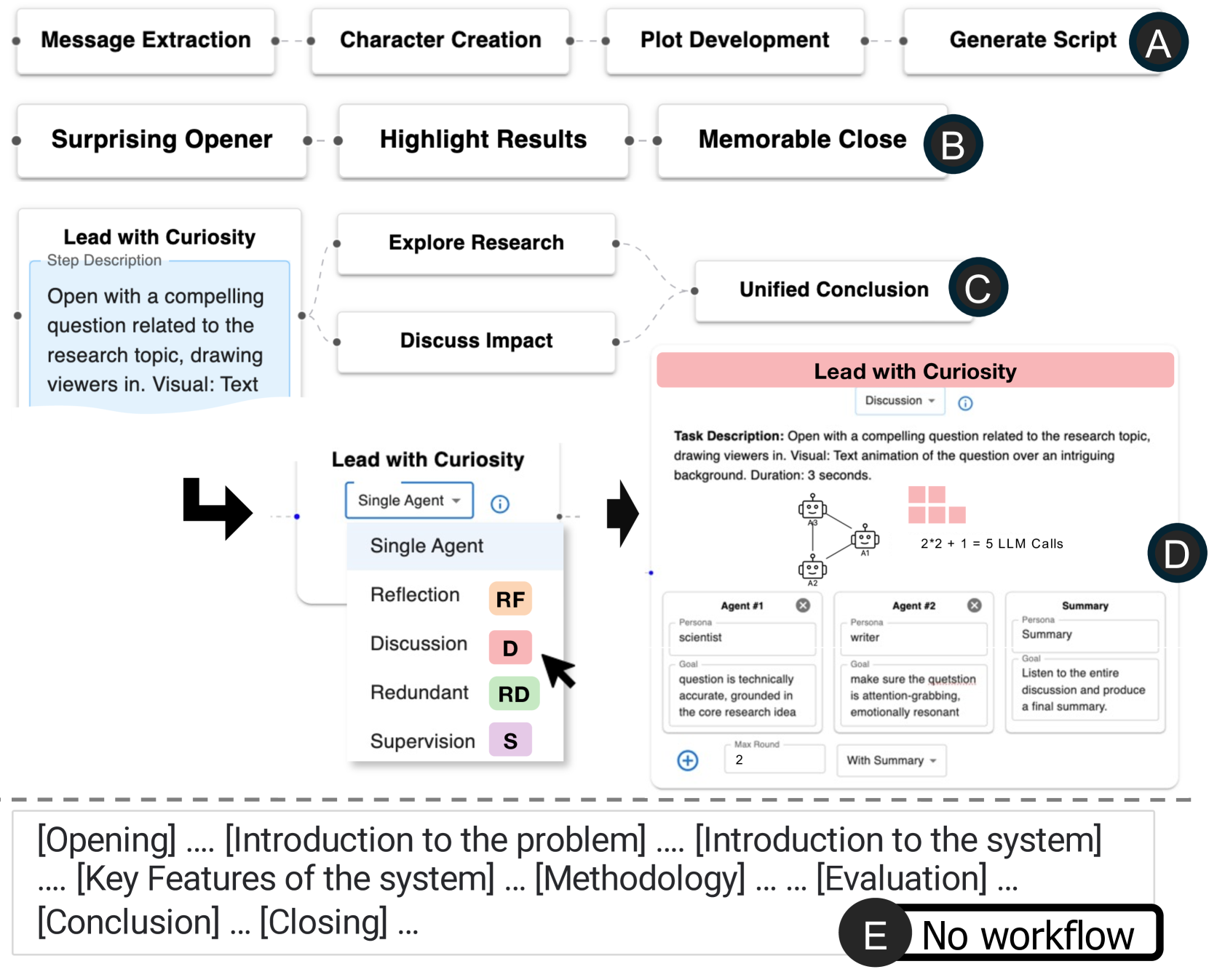
The image depicts a workflow diagram outlining the steps involved in generating a script, likely for a video or presentation. The workflow includes stages from message extraction to script generation, with a focus on a "Lead with Curiosity" step that involves agent interaction and task descriptions.
### Components/Axes
The diagram consists of the following key components:
* **A: Top Row**: High-level stages of the script generation process.
* Message Extraction
* Character Creation
* Plot Development
* Generate Script
* **B: Middle Row**: Refinement and finalization stages.
* Surprising Opener
* Highlight Results
* Memorable Close
* **C: Bottom Row**: Detailing the "Lead with Curiosity" step.
* Explore Research
* Discuss Impact
* Unified Conclusion
* **D: Detailed View of "Lead with Curiosity"**: A detailed breakdown of the "Lead with Curiosity" step, including task description, agent personas, and LLM call estimation.
* **E: Bottom Section**: A list of potential sections in a document or presentation, labeled "No workflow".
### Detailed Analysis or ### Content Details
**A: Top Row - High-Level Stages**
* **Message Extraction**: The initial step, presumably involving identifying key messages.
* **Character Creation**: Developing characters for the script.
* **Plot Development**: Constructing the storyline.
* **Generate Script**: The final stage of producing the script.
**B: Middle Row - Refinement Stages**
* **Surprising Opener**: Crafting an engaging introduction.
* **Highlight Results**: Showcasing key findings or outcomes.
* **Memorable Close**: Creating a lasting impression.
**C: Bottom Row - "Lead with Curiosity" Details**
* **Explore Research**: Investigating relevant research.
* **Discuss Impact**: Analyzing the implications of the research.
* **Unified Conclusion**: Forming a cohesive summary.
**D: Detailed View of "Lead with Curiosity"**
* **Lead with Curiosity (Title)**: The central focus of this detailed view.
* **Dropdown Menu**: A dropdown menu with the label "Single Agent" is visible. When clicked, it reveals the following options:
* Single Agent
* Reflection (RF) - Labeled with a light red color.
* Discussion (D) - Labeled with a dark red color.
* Redundant (RD) - Labeled with a light green color.
* Supervision (S) - Labeled with a light purple color.
* **Task Description**: "Open with a compelling question related to the research topic, drawing viewers in. Visual: Text animation of the question over an intriguing background. Duration: 3 seconds."
* **Agent Diagram**: A diagram showing the interaction between agents.
* Agent A3 connects to Agent A1.
* Agent A2 connects to Agent A1.
* **LLM Calls**: "2\*2 + 1 = 5 LLM Calls". A visual representation of 5 pink squares.
* **Agent #1**:
* Persona: Scientist
* Goal: "Question is technically accurate, grounded in the core research idea."
* **Agent #2**:
* Persona: Writer
* Goal: "Make sure the question is attention-grabbing, emotionally resonant."
* **Summary**:
* Persona: Summary
* Goal: "Listen to the entire discussion and produce a final summary."
* **Max Round**: A numerical input field with a value of "2".
* **With Summary**: A dropdown menu with the label "With Summary".
**E: Bottom Section - Document Sections**
* A list of potential sections in a document or presentation:
* [Opening]
* [Introduction to the problem]
* [Introduction to the system]
* [Key Features of the system]
* [Methodology]
* [Evaluation]
* [Conclusion]
* [Closing]
* Labeled "No workflow".
### Key Observations
* The diagram highlights the importance of crafting an engaging opening ("Lead with Curiosity").
* The "Lead with Curiosity" step involves multiple agents with distinct roles (scientist, writer, summary).
* The diagram estimates the number of LLM calls required for the "Lead with Curiosity" step.
* The bottom section suggests a standard structure for a document or presentation.
### Interpretation
The workflow diagram illustrates a structured approach to script generation, emphasizing the need for a compelling opening that draws the audience in. The "Lead with Curiosity" step is particularly detailed, suggesting its importance in the overall process. The use of multiple agents with different expertise highlights the collaborative nature of script creation. The estimation of LLM calls indicates a focus on optimizing resource usage. The "No workflow" label on the bottom section suggests that these elements are not part of the primary workflow but are related to the overall document structure.