## Diagram: Neural Network Architecture
### Overview
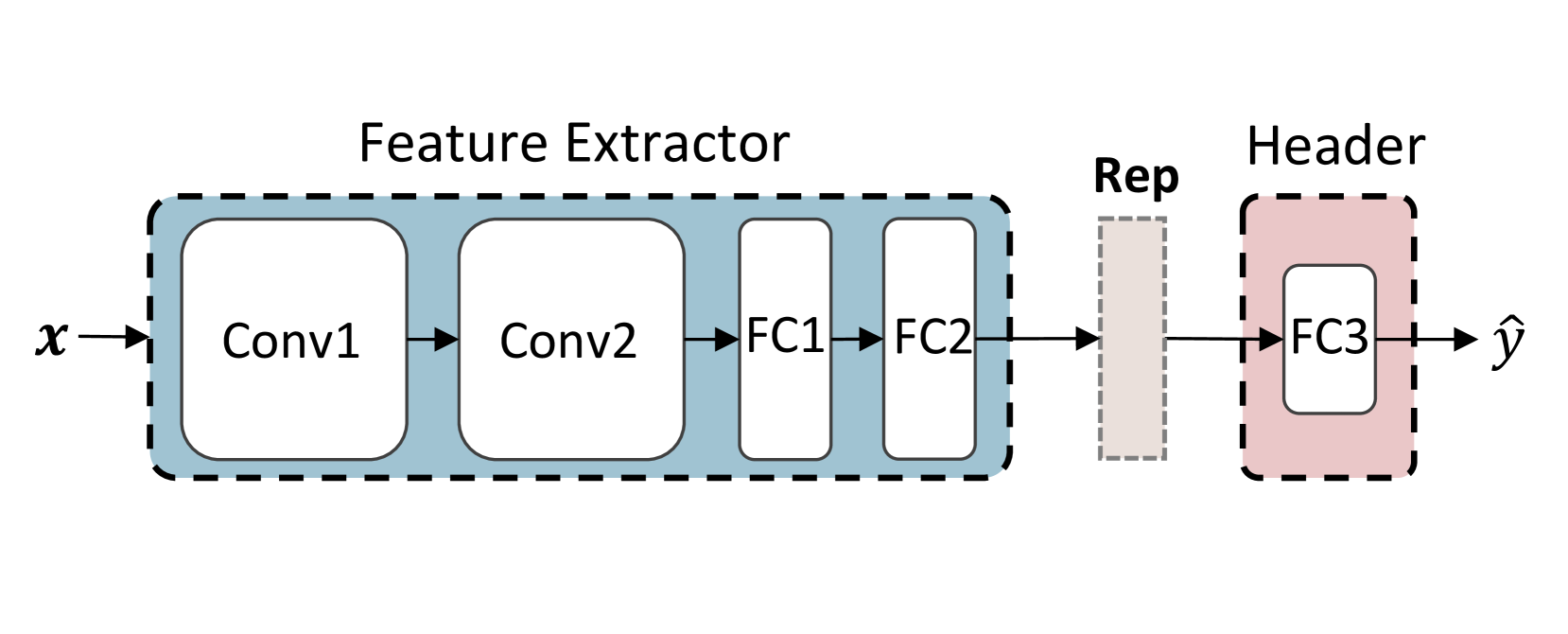
The diagram illustrates a neural network architecture divided into two main sections: **Feature Extractor** (blue dashed box) and **Header** (pink dashed box). The input `x` flows through the Feature Extractor, which includes convolutional and fully connected layers, followed by a **Rep** block (gray dashed rectangle), and finally the Header, which outputs the prediction `ŷ`.
### Components/Axes
- **Feature Extractor**:
- **Conv1**: Convolutional layer (first in the sequence).
- **Conv2**: Second convolutional layer.
- **FC1**: First fully connected layer.
- **FC2**: Second fully connected layer.
- **Rep**: A dashed gray rectangle labeled "Rep," positioned between FC2 and the Header.
- **Header**:
- **FC3**: Third fully connected layer, located within the pink dashed Header box.
- **Output**: `ŷ` (predicted value) is the final output of FC3.
### Detailed Analysis
- **Flow Direction**:
- Input `x` → Conv1 → Conv2 → FC1 → FC2 → Rep → FC3 → `ŷ`.
- **Color Coding**:
- **Blue**: Feature Extractor (Conv1, Conv2, FC1, FC2).
- **Pink**: Header (FC3).
- **Gray Dashed**: Rep block (intermediate processing).
- **Structural Notes**:
- The Rep block is a standalone module, possibly indicating a residual connection, repetition of features, or a specialized processing step.
- The Header is isolated from the Feature Extractor, suggesting modular design for tasks like classification or regression.
### Key Observations
1. **Modular Design**: The architecture separates feature extraction (Conv1, Conv2, FC1, FC2) from the final prediction (FC3), enabling independent optimization.
2. **Rep Block**: Its placement between FC2 and FC3 implies it modifies or enhances features before the final layer.
3. **Output**: The prediction `ŷ` is directly tied to FC3, indicating it is the classifier or regressor.
### Interpretation
This diagram represents a standard convolutional neural network (CNN) with a modular structure. The **Feature Extractor** processes raw input `x` through convolutional layers to capture spatial patterns, followed by fully connected layers (FC1, FC2) to reduce dimensionality. The **Rep block** may introduce redundancy or refine features, while the **Header** (FC3) performs the final prediction. The separation of modules suggests a design optimized for scalability, interpretability, or transfer learning. The absence of numerical values or explicit activation functions implies this is a high-level architectural schematic rather than a detailed implementation.