## Diagram: Grid Layout with Border
### Overview
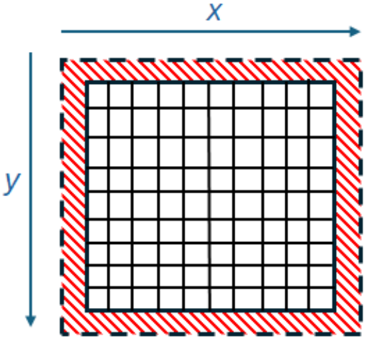
The image depicts a rectangular grid with a red-and-white striped border. The grid is composed of 10 columns (x-axis) and 10 rows (y-axis), forming 100 cells. No numerical data, labels, or annotations are present within the grid cells.
### Components/Axes
- **X-axis**: Labeled "x" at the top center, aligned horizontally.
- **Y-axis**: Labeled "y" at the left center, aligned vertically.
- **Border**: Red-and-white diagonal stripes form a dashed outline around the grid.
- **Grid Lines**: Black horizontal and vertical lines divide the grid into cells.
- **Legend**: Absent.
### Detailed Analysis
- **Grid Structure**:
- 10 columns (x-axis) and 10 rows (y-axis) create a 10x10 matrix.
- Cells are uniform in size but lack any embedded text, symbols, or shading.
- **Border Design**:
- Red-and-white diagonal stripes alternate in a repeating pattern.
- No text or identifiers within the border.
- **Absence of Data**:
- No numerical values, categorical labels, or data points are visible.
- No trend lines, annotations, or legends to interpret relationships.
### Key Observations
1. The grid is purely structural, with no embedded data or contextual information.
2. The striped border serves as a visual boundary but provides no functional or symbolic meaning.
3. The absence of a legend or axis scales suggests the grid is a template or placeholder.
### Interpretation
This diagram appears to represent a generic grid framework, potentially for future data visualization or spatial organization. The lack of numerical or categorical information implies it is not intended to convey specific data but rather to establish a structural template. The red-and-white border may symbolize a boundary or highlight the grid’s perimeter, though its purpose remains ambiguous without additional context. The uniformity of the grid suggests a focus on symmetry or modularity, which could be relevant in applications like tiling, pixel art, or coordinate-based systems.
**Note**: No factual or numerical data is present in the image. The description is based solely on visible structural elements.