## Diagram: Blockchain, AI Model Integrity, and Inference Challenges
### Overview
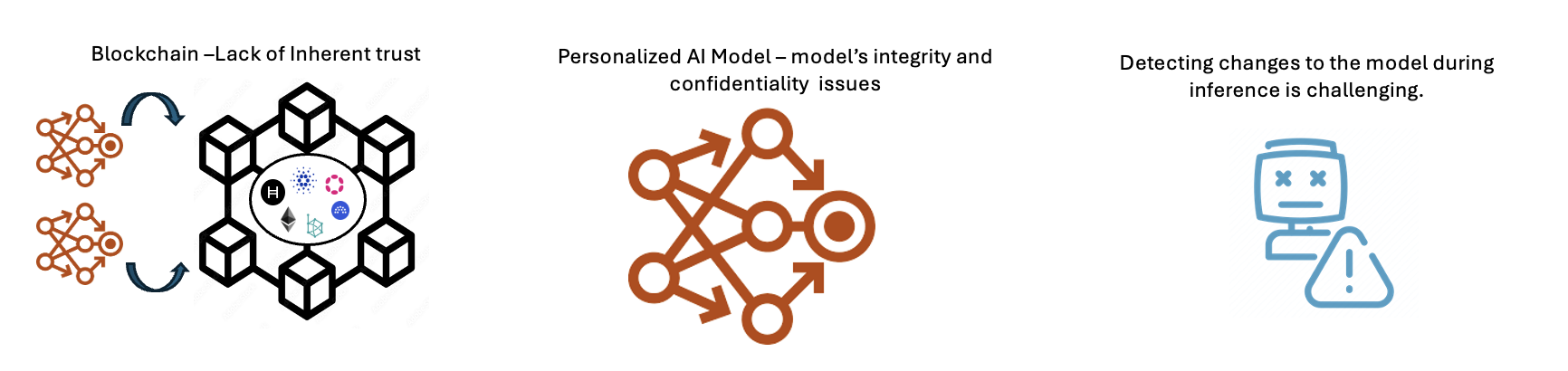
The image presents three interconnected diagrams illustrating challenges in blockchain technology, personalized AI models, and inference security. Each section uses symbolic visuals to represent technical concepts, with captions summarizing key issues.
### Components/Axes
1. **Blockchain Section**
- **Visual Elements**:
- Two clusters of interconnected nodes (orange circles with smaller circles) linked by bidirectional arrows.
- A central hexagonal structure with an oval containing symbols:
- "H" (likely Hyperledger),
- Ethereum diamond,
- Pink circle (possibly a token/coin),
- Blue circle with white dot (node/validator).
- **Caption**: "Blockchain – Lack of Inherent trust"
2. **Personalized AI Model Section**
- **Visual Elements**:
- A network of interconnected nodes (orange circles) with arrows forming a complex graph.
- One node highlighted with a concentric circle (target symbol).
- **Caption**: "Personalized AI Model – model’s integrity and confidentiality issues"
3. **Inference Challenges Section**
- **Visual Elements**:
- A robot face with two Xs for eyes and a warning triangle with an exclamation mark.
- **Caption**: "Detecting changes to the model during inference is challenging."
### Detailed Analysis
- **Blockchain Diagram**:
- The bidirectional arrows between node clusters suggest a decentralized network with mutual validation.
- The central hexagonal structure likely represents a consensus mechanism (e.g., proof-of-work/authority), with symbols denoting specific protocols or assets.
- The lack of "inherent trust" implies reliance on cryptographic verification rather than centralized authority.
- **AI Model Diagram**:
- The dense network of nodes represents data flow or model architecture.
- The highlighted node with a target symbol may indicate a critical component (e.g., model weights) vulnerable to tampering or data leakage.
- Arrows imply dependencies between model components, raising risks of adversarial attacks or bias propagation.
- **Inference Challenges Diagram**:
- The robot’s Xs and warning triangle symbolize threats (e.g., model poisoning, evasion attacks) during inference.
- The static nature of deployed models makes real-time change detection difficult, as noted in the caption.
### Key Observations
- **Blockchain**: Trust is maintained through distributed consensus, not inherent trust in participants.
- **AI Models**: Complex interdependencies increase vulnerability to integrity breaches.
- **Inference**: Static models lack mechanisms to detect adversarial modifications post-deployment.
### Interpretation
The diagrams collectively highlight systemic vulnerabilities in decentralized systems and AI:
1. **Blockchain’s Trust Model**: While decentralization reduces reliance on central authorities, it introduces challenges in resolving disputes or validating malicious actors.
2. **AI Integrity Risks**: Personalized models, often trained on sensitive data, are prone to confidentiality breaches (e.g., membership inference attacks) and adversarial manipulation.
3. **Inference Security**: The absence of dynamic monitoring tools exacerbates risks, as attackers can subtly alter model behavior without detection.
The visual metaphors (e.g., warning triangle, X-marked robot) emphasize the urgency of developing robust frameworks for trust, integrity, and real-time anomaly detection in these domains.