\n
## Diagram: Action-Perception Cycle
### Overview
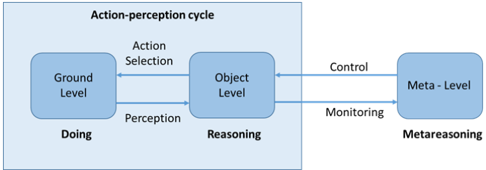
The image depicts a diagram illustrating the "Action-Perception Cycle". It shows a cyclical relationship between three levels: Ground Level, Object Level, and Meta-Level, with associated processes and descriptions. The diagram is contained within a light blue rectangular border.
### Components/Axes
The diagram consists of three main rectangular components representing levels of processing:
* **Ground Level:** Located on the left side of the diagram. Labeled "Ground Level" within the rectangle and "Doing" below it.
* **Object Level:** Positioned in the center of the diagram. Labeled "Object Level" within the rectangle and "Reasoning" below it.
* **Meta-Level:** Situated on the right side of the diagram. Labeled "Meta-Level" within the rectangle and "Metareasoning" below it.
Arrows connect these levels, indicating the flow of information and control. The arrows are labeled as follows:
* **Action Selection:** Arrow pointing from Ground Level to Object Level.
* **Perception:** Arrow pointing from Object Level to Ground Level.
* **Control:** Arrow pointing from Meta-Level to Object Level.
* **Monitoring:** Arrow pointing from Meta-Level to Ground Level.
The overall title of the diagram is "Action-perception cycle" and is positioned at the top center of the image.
### Detailed Analysis or Content Details
The diagram illustrates a feedback loop. The Ground Level ("Doing") initiates actions, which are then selected by the Object Level ("Reasoning"). The Object Level processes information and provides perception back to the Ground Level. The Meta-Level ("Metareasoning") monitors the Ground Level and exerts control over the Object Level.
The relationships are as follows:
1. Ground Level -> Object Level: Action Selection
2. Object Level -> Ground Level: Perception
3. Meta-Level -> Object Level: Control
4. Meta-Level -> Ground Level: Monitoring
The diagram does not contain numerical data or specific values. It is a conceptual representation of a process.
### Key Observations
The diagram emphasizes the interconnectedness of action and perception, and the role of a higher-level meta-cognitive process in regulating these interactions. The cyclical nature suggests a continuous process of action, perception, and refinement.
### Interpretation
The Action-Perception Cycle diagram represents a cognitive model of how agents interact with their environment. It suggests that actions are not simply initiated but are selected based on reasoning about the environment (Object Level). Perception provides feedback to refine actions, and a meta-level process monitors and controls the entire cycle. This model is relevant to fields such as robotics, artificial intelligence, and cognitive psychology. The diagram highlights the importance of feedback loops and hierarchical control in intelligent behavior. The absence of specific data suggests this is a general model rather than a representation of a specific experiment or dataset. The diagram is a conceptual framework for understanding how agents perceive, act, and learn.