## Diagram: Action-Perception Cycle Model
### Overview
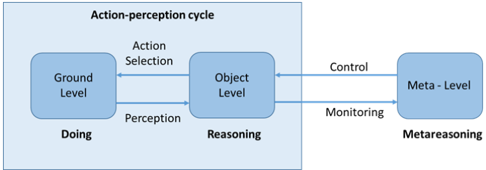
The image displays a conceptual block diagram illustrating a hierarchical model of cognition and action, titled "Action-perception cycle." It depicts three primary levels of processing—Ground Level, Object Level, and Meta-Level—and the bidirectional flows of information and control between them. The diagram is structured to show that the "Action-perception cycle" itself encompasses the interaction between the Ground and Object Levels, while the Meta-Level operates as a supervisory component outside this core cycle.
### Components/Axes
The diagram consists of three main rectangular blocks with rounded corners, connected by labeled arrows indicating directional relationships.
1. **Main Container Box:**
* **Label:** "Action-perception cycle"
* **Position:** A large, light-blue shaded rectangle that occupies the left and central portion of the image. It contains the "Ground Level" and "Object Level" blocks.
2. **Level Blocks:**
* **Ground Level Block:**
* **Position:** Leftmost block within the main container.
* **Primary Label (inside block):** "Ground Level"
* **Secondary Label (below block):** "Doing"
* **Object Level Block:**
* **Position:** Central block within the main container, to the right of the Ground Level.
* **Primary Label (inside block):** "Object Level"
* **Secondary Label (below block):** "Reasoning"
* **Meta-Level Block:**
* **Position:** Rightmost block, outside and to the right of the main "Action-perception cycle" container.
* **Primary Label (inside block):** "Meta - Level"
* **Secondary Label (below block):** "Metareasoning"
3. **Connecting Arrows & Labels:**
* **Arrow 1:** From "Ground Level" to "Object Level".
* **Label:** "Action Selection"
* **Arrow 2:** From "Object Level" to "Ground Level".
* **Label:** "Perception"
* **Arrow 3:** From "Meta-Level" to "Object Level".
* **Label:** "Control"
* **Arrow 4:** From "Object Level" to "Meta-Level".
* **Label:** "Monitoring"
### Detailed Analysis
The diagram defines a structured flow of information and command:
* **The Core Cycle (Within the "Action-perception cycle" box):**
* The **Ground Level ("Doing")** sends information to the **Object Level ("Reasoning")** via the **"Action Selection"** pathway. This suggests that concrete actions or states from the operational level inform the reasoning process.
* The **Object Level ("Reasoning")** sends information back to the **Ground Level ("Doing")** via the **"Perception"** pathway. This indicates that the reasoning process interprets or perceives the outcomes or states from the operational level, closing the loop.
* **The Supervisory Loop (Between the cycle and the Meta-Level):**
* The **Meta-Level ("Metareasoning")** exerts **"Control"** over the **Object Level ("Reasoning")**. This implies the meta-level sets goals, strategies, or constraints for the reasoning process.
* The **Object Level ("Reasoning")** provides **"Monitoring"** information to the **Meta-Level ("Metareasoning")**. This allows the meta-level to observe and assess the performance or state of the reasoning process.
### Key Observations
1. **Hierarchical Separation:** The "Meta-Level" is explicitly placed outside the "Action-perception cycle" box, visually emphasizing its role as an external supervisor or evaluator of the core reasoning-action loop.
2. **Bidirectional Communication:** All connections between levels are bidirectional, indicating a continuous feedback system rather than a simple top-down command chain.
3. **Label Consistency:** Each level has a dual label: a structural name (e.g., "Ground Level") and a functional descriptor (e.g., "Doing"). The functional descriptors clarify the primary activity at each stage.
4. **Flow Logic:** The arrow labels form logical pairs: "Action Selection" vs. "Perception" for the core cycle, and "Control" vs. "Monitoring" for the supervisory loop.
### Interpretation
This diagram models a cognitive architecture or a framework for intelligent systems (like AI or robotic agents). It suggests that effective intelligent behavior arises from the interaction of three distinct layers:
* **The Ground Level** is the interface with the world, responsible for execution ("Doing").
* **The Object Level** is the central processor that reasons about the world and the agent's goals, selecting actions and interpreting perceptions.
* **The Meta-Level** is a higher-order cognitive layer that doesn't reason about the world directly, but reasons about the *reasoning process itself* ("Metareasoning"). It monitors the Object Level's performance and controls its strategies, enabling learning, adaptation, and self-correction.
The separation of the "Action-perception cycle" highlights that the fundamental agent-environment interaction is a closed loop between action and perception. The Meta-Level's role is to optimize this loop from an external vantage point, making the system more flexible and robust. This structure is common in discussions of metacognition, hierarchical control systems, and advanced AI agent design.