## Diagram: Action-perception cycle
### Overview
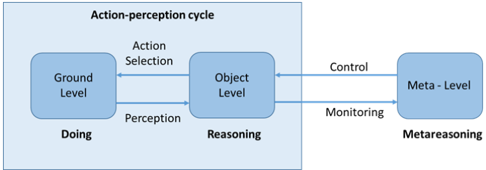
The diagram illustrates a cyclical process titled "Action-perception cycle," depicting interactions between three hierarchical levels: **Ground Level**, **Object Level**, and **Meta-Level**. Arrows indicate directional relationships and processes between these levels, with labels such as "Action Selection," "Perception," "Reasoning," "Control," and "Monitoring." The Meta-Level is explicitly linked to "Metareasoning."
### Components/Axes
- **Title**: "Action-perception cycle" (top of the diagram).
- **Main Boxes**:
- **Ground Level** (leftmost box, labeled "Doing" below it).
- **Object Level** (central box, labeled "Reasoning" below it).
- **Meta-Level** (rightmost box, labeled "Metareasoning" below it).
- **Arrows and Labels**:
- **Ground Level → Object Level**:
- "Action Selection" (top arrow).
- "Perception" (bottom arrow).
- **Object Level → Meta-Level**:
- "Control" (top arrow).
- "Monitoring" (bottom arrow).
### Detailed Analysis
- **Textual Labels**:
- All boxes and arrows are explicitly labeled with their respective functions.
- No numerical data or quantitative values are present.
- **Flow Direction**:
- The cycle is bidirectional between Ground Level and Object Level (via "Action Selection" and "Perception").
- Unidirectional flow from Object Level to Meta-Level (via "Control" and "Monitoring").
### Key Observations
- The diagram emphasizes a hierarchical and iterative process, with the Meta-Level acting as a supervisory layer.
- No numerical trends or outliers are present, as the diagram is conceptual rather than data-driven.
### Interpretation
The diagram represents a theoretical framework for understanding how actions, perceptions, and reasoning interact across different cognitive levels. The **Ground Level** focuses on immediate actions and sensory input ("Doing" and "Perception"), while the **Object Level** processes reasoning about objects or tasks. The **Meta-Level** introduces higher-order oversight ("Metareasoning"), enabling control and monitoring of lower-level processes. This structure suggests a feedback loop where actions and perceptions inform reasoning, which in turn guides and regulates subsequent actions. The absence of numerical data implies the diagram is a conceptual model rather than an empirical analysis.