## Vector Diagram: Velocity Components and Horizontal Derivative
### Overview
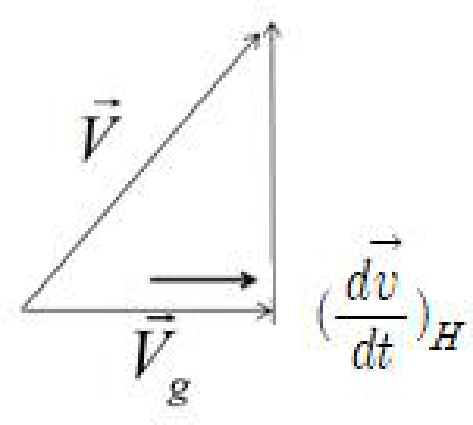
The image depicts a vector diagram illustrating the relationship between three vector quantities: a resultant velocity vector (V), a gravitational velocity component (V_g), and the horizontal derivative of velocity ((dv/dt)_H). The diagram uses arrows to represent vector directions and magnitudes, with labels and mathematical notation to define relationships.
### Components/Axes
- **Vectors**:
- **V**: Resultant velocity vector, oriented diagonally upward to the right.
- **V_g**: Gravitational velocity component, horizontal arrow pointing right.
- **(dv/dt)_H**: Horizontal derivative of velocity, labeled with a subscript "H" and arrow pointing right.
- **Axes**:
- No explicit axes are labeled, but the diagram implies a 2D coordinate system with horizontal (x-axis) and vertical (y-axis) components.
- **Legend**:
- No explicit legend is present, but vector colors (black for V, gray for V_g, and bold black for (dv/dt)_H) differentiate their roles.
### Detailed Analysis
- **Vector Relationships**:
- The resultant velocity **V** is the vector sum of **V_g** (horizontal) and an implied vertical component (not explicitly labeled).
- The horizontal derivative **(dv/dt)_H** is aligned with **V_g**, suggesting it represents the rate of change of the horizontal velocity component.
- **Mathematical Notation**:
- The term **(dv/dt)_H** indicates the horizontal acceleration or deceleration, critical for analyzing motion dynamics.
### Key Observations
1. **Directionality**: All vectors point to the right, implying motion or acceleration in the positive x-direction.
2. **Magnitude Proportions**:
- **V** is the longest vector, indicating it represents the total velocity magnitude.
- **V_g** and **(dv/dt)_H** are shorter, suggesting smaller magnitudes relative to **V**.
3. **Missing Labels**: The vertical component of **V** (likely representing vertical velocity, e.g., **V_y**) is unlabeled, leaving ambiguity about its role.
### Interpretation
This diagram likely models a physics scenario involving projectile motion, fluid flow, or mechanical systems where velocity components and their rates of change are analyzed. The horizontal derivative **(dv/dt)_H** suggests a focus on acceleration/deceleration in the x-direction, while **V_g** may represent a gravitational or external force component. The unlabeled vertical velocity component implies a simplification or omission, possibly assuming negligible vertical acceleration (e.g., in horizontal motion under constant gravity). The diagram emphasizes the decomposition of motion into horizontal and vertical components, with **(dv/dt)_H** highlighting dynamic changes in the horizontal velocity.
## Notes
- No numerical values or explicit scales are provided, limiting quantitative analysis.
- The absence of a legend or axis labels reduces clarity but aligns with simplified educational diagrams.
- The relationship between **V**, **V_g**, and **(dv/dt)_H** suggests a foundational physics problem, such as resolving forces or analyzing motion under external influences.