## Diagram Type: Flowcharts
### Overview
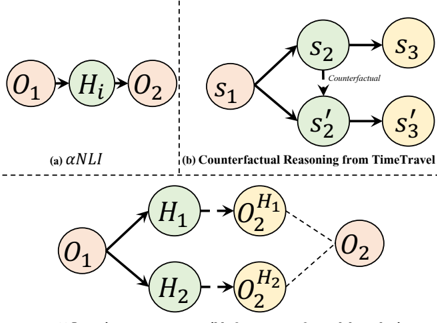
The image displays two flowcharts, labeled (a) and (b), which illustrate different concepts related to time travel and counterfactual reasoning.
### Components/Axes
- **Nodes**: Represent states or events, labeled as \( O_1 \), \( H_i \), \( O_2 \), \( s_1 \), \( s_2 \), \( s_3 \), \( s'_1 \), \( s'_2 \), \( s'_3 \), \( H_1 \), \( H_2 \), \( O_{H_1} \), \( O_{H_2} \).
- **Arrows**: Indicate the flow or relationship between nodes.
- **Legend**: Contains color-coded labels for different types of nodes or events.
- **Axes**: Not explicitly labeled, but likely represent time or different states.
### Detailed Analysis or ### Content Details
- **Flowchart (a)**: Shows a linear progression from \( O_1 \) to \( H_i \) to \( O_2 \). The arrow from \( O_1 \) to \( H_i \) is labeled with \( \alpha \text{NLI} \), suggesting a non-linear interaction or relationship.
- **Flowchart (b)**: Illustrates a more complex scenario with multiple paths. \( s_1 \) leads to \( s_2 \) and \( s_3 \), with a counterfactual arrow indicating a hypothetical alternative path. \( s'_1 \) leads to \( s'_2 \) and \( s'_3 \), also with a counterfactual arrow. The arrows from \( H_1 \) and \( H_2 \) lead to \( O_{H_1} \) and \( O_{H_2} \), respectively, suggesting a branching or diverging path.
### Key Observations
- **Counterfactual Reasoning**: Both flowcharts mention counterfactual reasoning, indicating a focus on hypothetical scenarios or alternative outcomes.
- **Time Travel**: The presence of \( s_1 \), \( s_2 \), \( s_3 \), \( s'_1 \), \( s'_2 \), \( s'_3 \), and \( H_1 \), \( H_2 \) suggests a concept of time travel or temporal manipulation.
- **Complexity**: Flowchart (b) is more complex, indicating a deeper exploration of time travel and counterfactual reasoning.
### Interpretation
The flowcharts appear to be illustrating the concept of counterfactual reasoning in the context of time travel. Flowchart (a) suggests a linear progression with a specific interaction labeled \( \alpha \text{NLI} \), while Flowchart (b) shows a more complex scenario with multiple paths and counterfactual arrows, indicating a deeper exploration of hypothetical scenarios and alternative outcomes. The use of color-coding in the legend helps to differentiate between different types of nodes or events, aiding in the understanding of the flowcharts.