## Line Chart: Effective Dimension vs. (2m+1)
### Overview
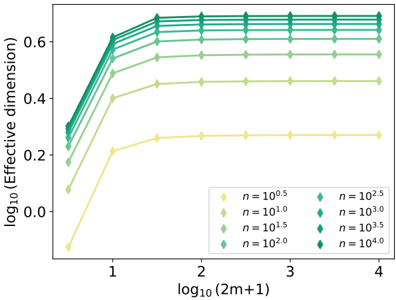
The image is a line chart showing the relationship between the base-10 logarithm of the effective dimension and the base-10 logarithm of (2m+1) for different values of 'n'. The chart contains multiple lines, each representing a different value of 'n' ranging from 10^0.5 to 10^4.0. The lines generally increase sharply at first and then plateau.
### Components/Axes
* **X-axis:** log₁₀(2m+1), with tick marks at 1, 2, 3, and 4.
* **Y-axis:** log₁₀(Effective dimension), with tick marks at 0.0, 0.2, 0.4, and 0.6.
* **Legend:** Located in the bottom-right corner, the legend maps the color of each line to a specific value of 'n':
* Yellow: n = 10⁰.⁵
* Light Yellow-Green: n = 10¹.⁰
* Yellow-Green: n = 10¹.⁵
* Green: n = 10².⁰
* Dark Green: n = 10².⁵
* Teal: n = 10³.⁰
* Dark Teal: n = 10³.⁵
* Darkest Teal: n = 10⁴.⁰
### Detailed Analysis
* **n = 10⁰.⁵ (Yellow):** The line starts at approximately -0.1 at log₁₀(2m+1) = 0, rises to approximately 0.23 at log₁₀(2m+1) = 1, and then plateaus around 0.28 for higher values of log₁₀(2m+1).
* **n = 10¹.⁰ (Light Yellow-Green):** The line starts at approximately 0.18 at log₁₀(2m+1) = 0, rises to approximately 0.40 at log₁₀(2m+1) = 1, and then plateaus around 0.46 for higher values of log₁₀(2m+1).
* **n = 10¹.⁵ (Yellow-Green):** The line starts at approximately 0.25 at log₁₀(2m+1) = 0, rises to approximately 0.52 at log₁₀(2m+1) = 1, and then plateaus around 0.57 for higher values of log₁₀(2m+1).
* **n = 10².⁰ (Green):** The line starts at approximately 0.28 at log₁₀(2m+1) = 0, rises to approximately 0.60 at log₁₀(2m+1) = 1, and then plateaus around 0.64 for higher values of log₁₀(2m+1).
* **n = 10².⁵ (Dark Green):** The line starts at approximately 0.30 at log₁₀(2m+1) = 0, rises to approximately 0.63 at log₁₀(2m+1) = 1, and then plateaus around 0.67 for higher values of log₁₀(2m+1).
* **n = 10³.⁰ (Teal):** The line starts at approximately 0.31 at log₁₀(2m+1) = 0, rises to approximately 0.65 at log₁₀(2m+1) = 1, and then plateaus around 0.69 for higher values of log₁₀(2m+1).
* **n = 10³.⁵ (Dark Teal):** The line starts at approximately 0.32 at log₁₀(2m+1) = 0, rises to approximately 0.66 at log₁₀(2m+1) = 1, and then plateaus around 0.70 for higher values of log₁₀(2m+1).
* **n = 10⁴.⁰ (Darkest Teal):** The line starts at approximately 0.33 at log₁₀(2m+1) = 0, rises to approximately 0.67 at log₁₀(2m+1) = 1, and then plateaus around 0.71 for higher values of log₁₀(2m+1).
### Key Observations
* All lines exhibit a similar trend: a sharp initial increase followed by a plateau.
* As 'n' increases, the plateau value of log₁₀(Effective dimension) also increases.
* The initial increase is most pronounced between log₁₀(2m+1) = 0 and log₁₀(2m+1) = 1.
* The lines appear to converge as 'n' increases, suggesting a limit to the effective dimension.
### Interpretation
The chart illustrates how the effective dimension changes with respect to (2m+1) for different values of 'n'. The data suggests that the effective dimension initially increases rapidly as (2m+1) increases, but eventually reaches a saturation point. The value of 'n' influences the saturation level, with higher 'n' values leading to higher effective dimensions. The convergence of the lines at higher 'n' values indicates that there may be an upper bound on the effective dimension, regardless of how large 'n' becomes. This could imply a limit to the complexity or dimensionality that the system can effectively represent.