## Memory Technology Timeline
### Overview
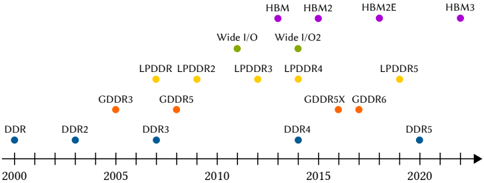
The image is a timeline illustrating the introduction of various memory technologies from approximately 2000 to 2020. The timeline displays different types of memory, including DDR, GDDR, LPDDR, Wide I/O, and HBM, showing their approximate release years.
### Components/Axes
* **X-axis:** Represents time, spanning from 2000 to 2020, with tick marks at 1-year intervals.
* **Y-axis:** Represents different memory technologies. The technologies are vertically arranged, with HBM at the top and DDR at the bottom.
* **Memory Technologies:**
* DDR (Dark Blue)
* GDDR (Orange)
* LPDDR (Yellow)
* Wide I/O (Green)
* HBM (Purple)
### Detailed Analysis
* **DDR Series (Dark Blue):**
* DDR: Appears around 2000.
* DDR2: Appears around 2003.
* DDR3: Appears around 2007.
* DDR4: Appears around 2014.
* DDR5: Appears around 2020.
* Trend: The DDR series shows a steady progression over time, with new generations appearing roughly every 3-7 years.
* **GDDR Series (Orange):**
* GDDR3: Appears around 2005.
* GDDR5: Appears around 2008.
* GDDR5X: Appears around 2015.
* GDDR6: Appears around 2017.
* Trend: The GDDR series also shows a progression, with new generations appearing at irregular intervals.
* **LPDDR Series (Yellow):**
* LPDDR: Appears around 2007.
* LPDDR2: Appears around 2009.
* LPDDR3: Appears around 2011.
* LPDDR4: Appears around 2014.
* LPDDR5: Appears around 2019.
* Trend: The LPDDR series shows a progression, with new generations appearing roughly every 2-3 years.
* **Wide I/O Series (Green):**
* Wide I/O: Appears around 2011.
* Wide I/O2: Appears around 2013.
* Trend: The Wide I/O series has only two data points on the timeline.
* **HBM Series (Purple):**
* HBM: Appears around 2014.
* HBM2: Appears around 2015.
* HBM2E: Appears around 2018.
* HBM3: Appears around 2020.
* Trend: The HBM series shows a progression, with new generations appearing roughly every 1-3 years.
### Key Observations
* The timeline provides a visual representation of the evolution of different memory technologies over time.
* Each memory technology series (DDR, GDDR, LPDDR, Wide I/O, HBM) shows a progression with new generations being introduced.
* The intervals between new generations vary across different memory technologies.
### Interpretation
The timeline illustrates the advancements in memory technology over the past two decades. It highlights the parallel development of different types of memory, each catering to specific needs and applications. The progression within each series indicates ongoing efforts to improve performance, capacity, and efficiency. The varying intervals between new generations suggest different rates of innovation and development for each technology. The presence of multiple memory types at any given time indicates that different technologies serve different purposes and markets, and that no single technology has completely replaced the others.