\n
## Timeline: Memory Technology Evolution
### Overview
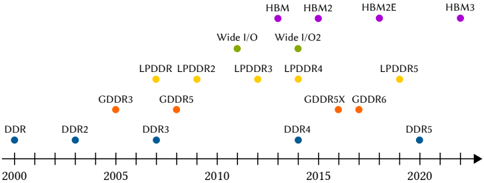
The image presents a timeline illustrating the evolution of various memory technologies from approximately 2000 to 2023. The timeline plots different memory standards (DDR, LPDDR, GDDR, HBM, and Wide I/O) against time, showing their approximate introduction years.
### Components/Axes
* **X-axis:** Represents time, ranging from 2000 to 2023. The axis is labeled with year markers at approximately 5-year intervals.
* **Y-axis:** Implicitly represents the different memory technologies. There is no explicit Y-axis label.
* **Memory Technologies:**
* DDR (Blue) - DDR, DDR2, DDR3, DDR4, DDR5
* LPDDR (Yellow) - LPDDR, LPDDR2, LPDDR3, LPDDR4, LPDDR5
* GDDR (Orange) - GDDR3, GDDR5, GDDR5X, GDDR6
* HBM (Purple) - HBM, HBM2, HBM2E, HBM3
* Wide I/O (Green) - Wide I/O, Wide I/O2
### Detailed Analysis
The timeline shows the following approximate introduction years for each memory technology:
* **DDR:**
* DDR: ~2000
* DDR2: ~2003
* DDR3: ~2007
* DDR4: ~2014
* DDR5: ~2021
* **LPDDR:**
* LPDDR: ~2008
* LPDDR2: ~2010
* LPDDR3: ~2012
* LPDDR4: ~2015
* LPDDR5: ~2019
* **GDDR:**
* GDDR3: ~2007
* GDDR5: ~2012
* GDDR5X: ~2016
* GDDR6: ~2018
* **HBM:**
* HBM: ~2013
* HBM2: ~2016
* HBM2E: ~2019
* HBM3: ~2022
* **Wide I/O:**
* Wide I/O: ~2010
* Wide I/O2: ~2014
The data points are arranged horizontally along the timeline, indicating the approximate year of introduction for each technology. The technologies are visually separated by color, as indicated in the legend.
### Key Observations
* DDR technology has the longest history, starting around 2000 and continuing with new iterations up to 2021.
* LPDDR and GDDR technologies emerged around 2008 and 2007 respectively, and have also seen multiple iterations.
* HBM is a relatively newer technology, appearing around 2013, but has rapidly evolved with new versions.
* Wide I/O is a less prominent technology, with only two iterations shown, and a shorter lifespan on the timeline.
* There is a general trend of new memory technologies and iterations being introduced at increasing frequency over time.
### Interpretation
The timeline demonstrates the continuous innovation in memory technology driven by demands for higher bandwidth, lower power consumption, and increased capacity. The introduction of new standards like HBM and the evolution of existing standards like DDR, LPDDR, and GDDR reflect the industry's efforts to meet the evolving needs of computing applications. The overlapping timelines of different memory technologies suggest that they often target different market segments or applications, rather than directly competing with each other. For example, LPDDR is often used in mobile devices due to its low power consumption, while GDDR is commonly used in graphics cards due to its high bandwidth. HBM is used in high-performance computing and data centers. The increasing rate of innovation suggests that the pace of development in memory technology is accelerating.