## Timeline Chart: Evolution of Memory Technologies (2000–2020)
### Overview
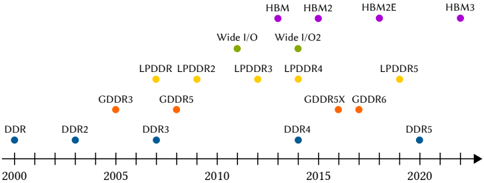
The chart illustrates the chronological development of memory technologies from 2000 to 2020, categorized by type (DDR, GDDR, LPDDR, HBM, Wide I/O) and version. Data points are color-coded and positioned along a horizontal timeline, with vertical labels indicating technology families.
### Components/Axes
- **X-axis**: Years (2000–2020), marked at 5-year intervals.
- **Y-axis**: Memory technology families (DDR, GDDR, LPDDR, HBM, Wide I/O), listed from bottom to top.
- **Legend**: Located on the right, mapping colors to technology families:
- **Blue**: DDR
- **Orange**: GDDR
- **Yellow**: LPDDR
- **Green**: Wide I/O
- **Purple**: HBM
### Detailed Analysis
1. **DDR Series** (Blue):
- **DDR**: 2000
- **DDR2**: 2003
- **DDR3**: 2007
- **DDR4**: 2012
- **DDR5**: 2018
- *Trend*: Releases occur approximately every 3–5 years, with DDR5 being the latest version.
2. **GDDR Series** (Orange):
- **GDDR3**: 2005
- **GDDR5**: 2010
- **GDDR5X**: 2016
- **GDDR6**: 2017
- *Trend*: Focused on graphics applications, with GDDR6 being the most recent.
3. **LPDDR Series** (Yellow):
- **LPDDR**: 2007
- **LPDDR2**: 2007
- **LPDDR3**: 2011
- **LPDDR4**: 2014
- **LPDDR5**: 2017
- *Trend*: Designed for low-power applications, with LPDDR5 as the latest iteration.
4. **HBM Series** (Purple):
- **HBM**: 2013
- **HBM2**: 2015
- **HBM2E**: 2017
- **HBM3**: 2020
- *Trend*: High-bandwidth memory for advanced computing, with annual updates in later versions.
5. **Wide I/O Series** (Green):
- **Wide I/O**: 2011
- **Wide I/O2**: 2013
- *Trend*: Focused on high-speed data transfer, with no newer versions shown.
### Key Observations
- **DDR5** (2018) and **HBM3** (2020) represent the most recent advancements in their respective categories.
- **LPDDR5** (2017) and **GDDR6** (2017) were released in the same year, indicating parallel innovation in low-power and graphics memory.
- **HBM** versions (2013–2020) show a rapid evolution, with HBM3 being the latest in 2020.
- **GDDR5X** (2016) and **GDDR6** (2017) highlight a focus on graphics performance improvements.
### Interpretation
The chart demonstrates a clear progression in memory technology over two decades, with each generation introducing higher performance, efficiency, or specialization:
- **DDR** evolved into **DDR5** (2018), emphasizing increased bandwidth and power efficiency for general computing.
- **GDDR** advanced to **GDDR6** (2017), targeting high-performance graphics with improved data rates.
- **LPDDR** reached **LPDDR5** (2017), optimizing for mobile and embedded systems with reduced power consumption.
- **HBM** versions (2013–2020) reflect a shift toward high-bandwidth memory for AI, gaming, and data centers, with HBM3 (2020) marking a significant leap in capacity and speed.
- **Wide I/O** (2011–2013) highlights early efforts in high-speed data transfer, though no newer versions are shown.
The staggered release timeline suggests competitive innovation, with technologies like HBM and LPDDR addressing niche markets (high-performance computing and low-power devices, respectively). The absence of newer Wide I/O versions after 2013 may indicate market saturation or a shift toward alternative standards like HBM.