## Diagram: Dimensionality and Bit Array Representation
### Overview
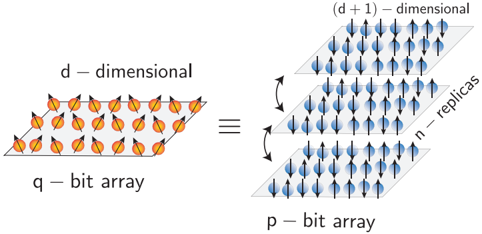
The image illustrates the relationship between a 'd-dimensional' and a '(d+1)-dimensional' bit array representation. The left side shows a single layer representing a 'q-bit array', while the right side shows a stack of 'n-replicas' representing a 'p-bit array'. The equivalence between the two representations is visually emphasized.
### Components/Axes
* **Left Side:**
* **Array Type:** d-dimensional, q-bit array
* **Elements:** Orange spheres with black arrows pointing in various directions. The spheres are arranged in a grid pattern on a light gray plane.
* **Center:**
* **Symbol:** An equals sign (=) indicating equivalence.
* **Right Side:**
* **Array Type:** (d+1)-dimensional, p-bit array, n-replicas
* **Elements:** Blue spheres with black arrows pointing downwards. The spheres are arranged in a grid pattern on three stacked light gray planes.
* **Replicas:** Three layers are stacked vertically, labeled as 'n - replicas' on the right side.
* **Arrows:** Curved black arrows on the left side of the stacked arrays indicate the relationship between the layers.
### Detailed Analysis
* **Left Array (d-dimensional, q-bit array):**
* The array consists of 5 rows and 5 columns of orange spheres, totaling 25 spheres.
* Each sphere has a black arrow indicating a direction, which varies from sphere to sphere.
* **Right Array ((d+1)-dimensional, p-bit array):**
* The array consists of three layers (n-replicas).
* Each layer has 5 rows and 5 columns of blue spheres, totaling 25 spheres per layer.
* Each sphere has a black arrow pointing downwards.
* The layers are stacked vertically, suggesting an additional dimension.
### Key Observations
* The left side represents a lower-dimensional array with variable arrow directions, while the right side represents a higher-dimensional array with uniform arrow directions.
* The number of spheres in each layer of the right array is the same as the number of spheres in the left array (25).
* The 'n-replicas' label suggests that the number of layers can vary.
### Interpretation
The diagram illustrates a concept of representing a lower-dimensional bit array (q-bit array) as a higher-dimensional array (p-bit array) using multiple replicas. The equivalence sign suggests that both representations are functionally equivalent, but the higher-dimensional representation might offer advantages in certain contexts, such as error correction or parallel processing. The arrows represent the state of each bit, and the change in arrow direction from variable to uniform suggests a transformation or encoding process. The 'n-replicas' indicate that the higher-dimensional representation can be scaled by increasing the number of layers.