## Diagram: Transformation of Bit Arrays Across Dimensional Spaces
### Overview
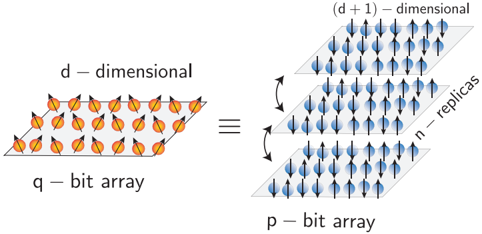
The diagram illustrates a conceptual transformation between two bit arrays: a **d-dimensional q-bit array** (left) and a **(d + 1)-dimensional p-bit array** (right). Arrows indicate bidirectional relationships, with annotations for dimensionality, replication, and array types.
### Components/Axes
- **Left Panel**:
- Label: "d-dimensional q-bit array"
- Visual: Grid of orange arrows (representing qubits) arranged in a 2D lattice.
- Arrows: Black double-headed arrows pointing diagonally, suggesting directional relationships between qubits.
- **Right Panel**:
- Label: "(d + 1)-dimensional p-bit array"
- Subcomponents:
1. Top layer: Grid of blue arrows (representing p-bits) in a 3D-like lattice.
2. Middle layer: Labeled "n - replicas" (horizontal stack of identical blue arrow grids).
3. Bottom layer: Labeled "p-bit array" (single grid of blue arrows).
- Arrows: Black double-headed arrows connecting layers vertically and horizontally.
- **Legend/Annotations**:
- Colors: Orange (q-bit array), Blue (p-bit array).
- Text: "n - replicas" (middle layer), "p-bit array" (bottom layer).
### Detailed Analysis
- **Dimensionality**:
- Left: Explicitly labeled as **d-dimensional** (2D representation).
- Right: Explicitly labeled as **(d + 1)-dimensional** (3D-like representation).
- **Replication**:
- Middle layer of the right panel contains **n replicas** of the p-bit array, indicating repeated instances of the same structure.
- **Arrow Directions**:
- Left panel: Diagonal arrows suggest inter-qubit interactions or entanglement.
- Right panel: Vertical arrows between layers imply hierarchical relationships (e.g., replication or stacking). Horizontal arrows suggest parallel processing or synchronization.
### Key Observations
1. **Dimensional Expansion**: The transformation from q-bit to p-bit arrays increases dimensionality by 1 (d → d + 1).
2. **Replication Mechanism**: The "n - replicas" layer suggests a multiplicative process, possibly for redundancy or parallel computation.
3. **Bidirectional Arrows**: Implies reversible or symmetric relationships between the arrays (e.g., encoding/decoding, transformation/inversion).
### Interpretation
This diagram likely represents a quantum computing or information theory concept:
- **Qubit to P-Bit Transformation**: The increase in dimensionality (d → d + 1) may reflect encoding quantum states (qubits) into classical or higher-dimensional classical states (p-bits), a common step in quantum error correction or simulation.
- **Replication (n replicas)**: The middle layer’s replication could symbolize error correction codes (e.g., surface codes) or parallel processing architectures.
- **Bidirectional Arrows**: Suggests the process is reversible, critical for quantum operations where transformations must be unitary (preserving information).
The diagram emphasizes the interplay between dimensionality, replication, and directional relationships in bit array transformations, with color coding (orange/blue) distinguishing array types. No numerical data or trends are present, but the structural relationships imply a framework for scalable quantum-classical hybrid systems.