## Diagram: Comparison of Objects in Containers
### Overview
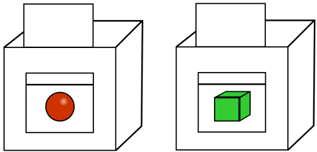
The image consists of two identical, stylized line-art containers placed side-by-side. Each container features a rectangular window on its front face and a white sheet of paper protruding from the top. The left container holds a red sphere, while the right container holds a green cube.
### Components/Axes
There are no axes, legends, or text labels in this image. The components are defined by their spatial arrangement and visual properties:
* **Left Container:**
* **Structure:** A white, box-like shape drawn in perspective.
* **Front Window:** A rectangular cutout on the front face.
* **Content:** A red sphere, shaded to appear three-dimensional.
* **Top:** A white rectangular sheet of paper protruding vertically.
* **Right Container:**
* **Structure:** A white, box-like shape drawn in perspective, identical to the left container.
* **Front Window:** A rectangular cutout on the front face.
* **Content:** A green cube, drawn in perspective to appear three-dimensional.
* **Top:** A white rectangular sheet of paper protruding vertically.
### Detailed Analysis
* **Spatial Grounding:** The two containers are positioned horizontally, with the "Red Sphere" container on the left and the "Green Cube" container on the right.
* **Visual Consistency:** The containers themselves are identical in line weight, perspective, and dimensions. This establishes a "control" environment where the container is the constant and the internal object is the variable.
* **Object Properties:**
* **Left Object:** A sphere. The color is a solid, saturated red with a lighter highlight on the upper right to suggest volume.
* **Right Object:** A cube. The color is a solid, saturated green. The perspective shows three faces of the cube, clearly defining it as a hexahedron.
### Key Observations
* **Binary Contrast:** The image presents a clear binary distinction between two geometric primitives (sphere vs. cube) and two primary colors (red vs. green).
* **Uniformity:** The identical nature of the containers suggests that the system or process receiving these objects is the same, regardless of the object's shape or color.
* **Absence of Text:** There is no textual information provided, indicating the meaning is intended to be derived purely from the visual symbols.
### Interpretation
This diagram functions as a visual representation of **categorization, sorting, or input processing**.
* **Functional Meaning:** The presence of the paper at the top of the boxes strongly implies these are receptacles—such as ballot boxes, suggestion boxes, or mail slots. The objects inside (the sphere and the cube) represent the "data" or "items" being deposited into these receptacles.
* **Peircean Investigative Perspective:**
* **The Signifier:** The boxes act as a "system" or "container." The objects act as "inputs."
* **The Relationship:** By placing different objects into identical containers, the image illustrates the concept of *classification*. It asks the viewer to recognize the difference between the two inputs (Red/Sphere vs. Green/Cube) while acknowledging they are being treated by the same process or system.
* **Reading Between the Lines:** This could be a simplified schematic for a sorting algorithm or a logic puzzle. It demonstrates that the "container" (the system) is agnostic to the "content" (the data), or conversely, it highlights the distinct nature of the two items being compared. The lack of text forces the viewer to focus entirely on the geometric and chromatic differences between the two subjects.