\n
## Diagram: Isometric Cube with Internal Objects
### Overview
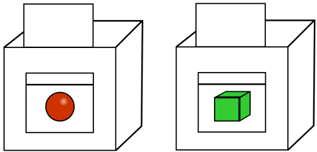
The image depicts two isometric projections of open cubes. Each cube contains a single, distinct geometric object within its interior. The left cube contains a sphere, and the right cube contains a smaller cube. The diagram appears to be illustrative, likely demonstrating spatial relationships or object containment.
### Components/Axes
There are no explicit axes or scales present in the image. The components are:
* **Cube Structure:** Two open cubes, rendered in an isometric view. The cubes are outlined in black.
* **Sphere:** A red sphere positioned within the left cube.
* **Smaller Cube:** A green cube positioned within the right cube.
### Detailed Analysis or Content Details
The image shows two separate scenes.
**Left Cube:**
* The cube is open at the top and front.
* Inside the cube, centered in the lower portion, is a red sphere. The sphere appears to be approximately 1/3 the height of the cube.
**Right Cube:**
* The cube is open at the top and front, mirroring the left cube's orientation.
* Inside the cube, centered in the lower portion, is a green cube. The green cube appears to be approximately 1/3 the height of the cube.
### Key Observations
* Both cubes are identical in structure and orientation.
* The internal objects (sphere and cube) are similarly positioned within their respective cubes.
* The objects differ in shape and color.
### Interpretation
The diagram likely illustrates a concept related to containment, shape, or spatial reasoning. The use of different shapes and colors within identical structures could be used to demonstrate:
* **Object Recognition:** Distinguishing between different geometric forms.
* **Spatial Relationships:** Understanding how objects fit within a defined space.
* **Visual Comparison:** Highlighting the differences between a sphere and a cube.
* **Conceptual Illustration:** The image could be part of a larger explanation of geometric principles or problem-solving.
The simplicity of the diagram suggests it is intended for introductory or foundational learning, rather than complex analysis. There are no numerical values or data points to analyze; the image is purely visual and conceptual.