## Diagram: Two Boxes with Internal Shapes
### Overview
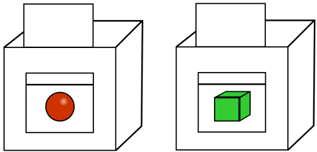
The image is a simple line-drawing diagram depicting two identical, open-topped rectangular boxes placed side-by-side. Each box contains a smaller, centered rectangular frame on its front face, and a smaller, empty rectangular box sits atop each main box. The key difference is the geometric shape depicted inside the front frame of each main box.
### Components/Axes
* **Main Structure:** Two identical 3D rectangular boxes (cuboids) shown in a parallel, side-by-side arrangement.
* **Top Element:** A smaller, empty rectangular box (cuboid) is positioned on the top surface of each main box.
* **Front Frame:** A rectangular frame is centered on the front face of each main box.
* **Internal Shapes:**
* **Left Box:** Contains a solid red sphere (circle with shading to imply 3D form) centered within the front frame.
* **Right Box:** Contains a solid green cube (hexagon with internal lines to imply 3D form) centered within the front frame.
* **Text/Labels:** There is **no textual information** present in this diagram. No labels, titles, legends, or annotations are visible.
### Detailed Analysis
* **Spatial Grounding:** The diagram is symmetric. The left and right boxes are mirror images in structure, differing only in the internal shape and its color.
* **Color & Shape Correlation:**
* The **red** color is exclusively associated with the **spherical** shape in the left box.
* The **green** color is exclusively associated with the **cubic** shape in the right box.
* **Component Isolation:**
* **Header Region:** Empty white space above the boxes.
* **Main Diagram Region:** Contains the two primary boxes and their associated top boxes and internal shapes.
* **Footer Region:** Empty white space below the boxes.
### Key Observations
1. The diagram presents a clear visual contrast between two fundamental 3D geometric primitives: a sphere and a cube.
2. The use of distinct, primary colors (red and green) reinforces the dichotomy between the two objects.
3. The identical framing (the boxes and front frames) suggests the two shapes are being presented for direct comparison under similar conditions or contexts.
4. The absence of any text or data makes this a purely symbolic or conceptual illustration.
### Interpretation
This diagram is likely a conceptual illustration used to represent a binary distinction or comparison. The pairing of a **red sphere** and a **green cube** inside identical containers is a common visual metaphor for contrasting two different states, types, or properties.
* **Possible Symbolic Meanings:**
* **Organic vs. Geometric:** The sphere (smooth, continuous, natural) versus the cube (angular, discrete, man-made).
* **Analog vs. Digital:** The sphere representing continuous, analog signals or forms, and the cube representing discrete, digital data or blocks.
* **State A vs. State B:** A simple visual code for two different conditions, options, or categories within a system.
* **Relationship:** The identical boxes imply that the "container" or "system" is the same, but the "content" or "state" within is fundamentally different. The small boxes on top could represent an input, output, or interface point common to both systems.
* **Why it Matters:** Such diagrams are foundational in technical, scientific, and philosophical contexts to visually communicate core dichotomies before introducing complex details. It serves as a visual axiom. The lack of text makes it universally understandable, relying on the inherent symbolic power of basic shapes and colors.