## Diagram: Comparative Object Representation
### Overview
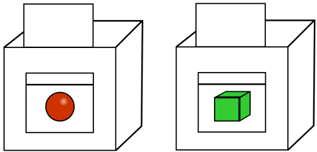
The image depicts two identical white cubic containers positioned side by side. Each container has a distinct colored object embedded within its central compartment: a red sphere in the left container and a green cube in the right container. Both objects are centrally aligned within their respective compartments, with no additional textual or graphical elements present.
### Components/Axes
- **Primary Elements**:
- Two white cubic containers (identical in size and shape).
- Left container: Contains a red sphere.
- Right container: Contains a green cube.
- **Spatial Relationships**:
- Containers are positioned horizontally adjacent to each other.
- Left container is slightly advanced in depth relative to the right container (perspective effect).
- No overlapping or interaction between the containers or objects.
### Detailed Analysis
- **Object Properties**:
- **Red Sphere**: Perfectly round, uniformly colored, and centered within the left container’s compartment.
- **Green Cube**: Three-dimensional, with visible edges and shading to indicate depth, centered within the right container’s compartment.
- **Container Design**:
- Both containers have a hollow, open-top structure with a flat base.
- No visible hinges, lids, or additional compartments.
- **Color Coding**:
- Red and green are used to differentiate the objects, with no other colors present.
### Key Observations
1. **Symmetry and Contrast**: The containers are identical in form but differ in the objects they hold, emphasizing a comparative relationship.
2. **Color Significance**: Red and green are primary colors, potentially indicating categorical distinctions (e.g., "sphere vs. cube" or "active vs. inactive").
3. **Perspective Effect**: The slight advancement of the left container creates a sense of depth, though no 3D interaction is implied.
### Interpretation
The diagram likely serves as a visual metaphor or instructional aid to highlight differences in shape, color, or function. The absence of text or labels suggests the comparison relies solely on visual cues. The use of a sphere and cube may symbolize contrasting properties (e.g., fluidity vs. rigidity, or organic vs. geometric forms). The simplicity of the design implies it could be used in educational contexts, user interface elements, or abstract conceptual models.
**Note**: No textual data, numerical values, or explicit legends are present in the image. The analysis is based solely on visual components and spatial relationships.