## Sudoku Grid with Error Highlighting
### Overview
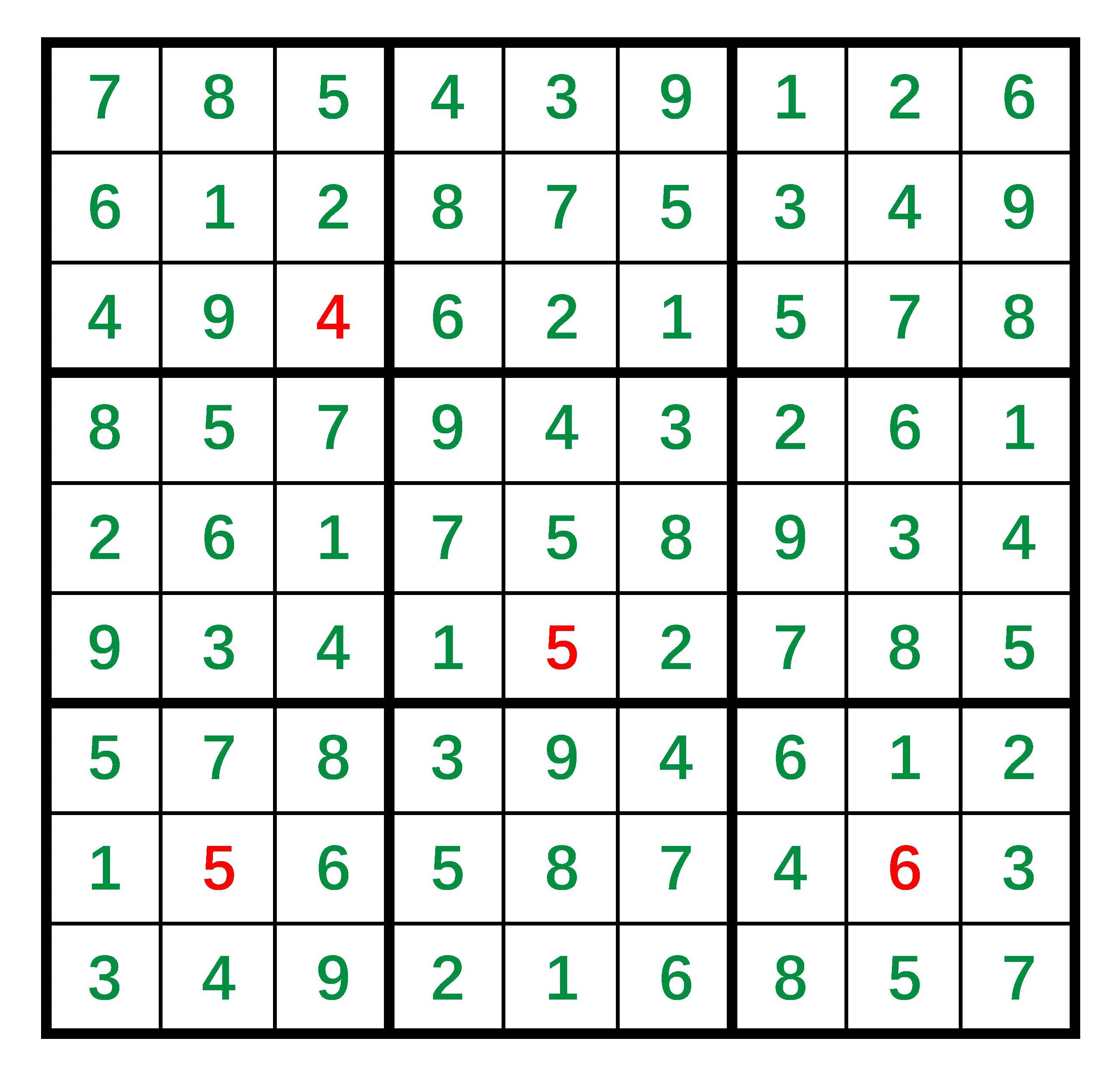
The image displays a standard 9x9 Sudoku puzzle grid. The grid is fully populated with numbers from 1 to 9. Most numbers are rendered in green, while four specific numbers are highlighted in red, indicating they are likely incorrect entries that violate Sudoku rules. The grid is divided into nine 3x3 subgrids (boxes) by thick black borders.
### Components/Axes
* **Structure:** A 9x9 grid composed of 81 individual cells.
* **Subdivision:** The grid is divided into nine 3x3 boxes, demarcated by thicker black lines.
* **Content:** Each cell contains a single digit from 1 to 9.
* **Color Coding:**
* **Green Text:** The majority of the numbers.
* **Red Text:** Four specific numbers, indicating errors or user-inputted values that conflict with Sudoku constraints.
* **Labels/Axes:** There are no row/column labels, axis titles, or legends present. The grid is self-contained.
### Detailed Analysis
The grid is completely filled. Below is the transcription of all 81 cells, organized by row (R) and column (C). Red entries are noted.
**Row 1:** R1C1=7, R1C2=8, R1C3=5, R1C4=4, R1C5=3, R1C6=9, R1C7=1, R1C8=2, R1C9=6
**Row 2:** R2C1=6, R2C2=1, R2C3=2, R2C4=8, R2C5=7, R2C6=5, R2C7=3, R2C8=4, R2C9=9
**Row 3:** R3C1=4, R3C2=9, **R3C3=4 (RED)**, R3C4=6, R3C5=2, R3C6=1, R3C7=5, R3C8=7, R3C9=8
**Row 4:** R4C1=8, R4C2=5, R4C3=7, R4C4=9, R4C5=4, R4C6=3, R4C7=2, R4C8=6, R4C9=1
**Row 5:** R5C1=2, R5C2=6, R5C3=1, R5C4=7, R5C5=5, R5C6=8, R5C7=9, R5C8=3, R5C9=4
**Row 6:** R6C1=9, R6C2=3, R6C3=4, R6C4=1, **R6C5=5 (RED)**, R6C6=2, R6C7=7, R6C8=8, R6C9=5
**Row 7:** R7C1=5, R7C2=7, R7C3=8, R7C4=3, R7C5=9, R7C6=4, R7C7=6, R7C8=1, R7C9=2
**Row 8:** R8C1=1, **R8C2=5 (RED)**, R8C3=6, R8C4=5, R8C5=8, R8C6=7, R8C7=4, **R8C8=6 (RED)**, R8C9=3
**Row 9:** R9C1=3, R9C2=4, R9C3=9, R9C4=2, R9C5=1, R9C6=6, R9C7=8, R9C8=5, R9C9=7
### Key Observations
1. **Error Locations:** The four red numbers are located at:
* Row 3, Column 3 (Value: 4)
* Row 6, Column 5 (Value: 5)
* Row 8, Column 2 (Value: 5)
* Row 8, Column 8 (Value: 6)
2. **Rule Violations:** The red numbers create direct conflicts:
* **R3C3 (4):** Duplicates the 4 in Row 3 (R3C1) and in the top-left 3x3 box (R3C1).
* **R6C5 (5):** Duplicates the 5 in Row 6 (R6C9) and in the central 3x3 box (R5C5).
* **R8C2 (5):** Duplicates the 5 in Row 8 (R8C4) and in the bottom-left 3x3 box (R7C1).
* **R8C8 (6):** Duplicates the 6 in Row 8 (R8C3) and in the bottom-right 3x3 box (R7C7).
3. **Pattern:** All errors are duplicates within their respective row, column, or 3x3 box, which is the core constraint of Sudoku. The red highlighting serves as an error-detection mechanism.
### Interpretation
This image is not a puzzle to be solved, but rather a **diagnostic or educational display**. It presents a *completed* Sudoku grid where the red numbers explicitly flag logical inconsistencies. The purpose is likely to:
* **Demonstrate Sudoku Rules:** Visually teach the constraints of the game by showing clear violations.
* **Illustrate Error Checking:** Serve as an example for a program or process that validates Sudoku solutions and highlights mistakes.
* **Provide a Test Case:** Act as a known-incorrect input for testing Sudoku-solving or validation algorithms.
The grid itself contains no external data or trends; its informational value lies entirely in the relationship between the numbers and the highlighted errors. The absence of any other text or labels focuses the viewer's attention solely on the numerical logic and the color-coded feedback.