## Sudoku Grid: Completed Puzzle with Highlighted Numbers
### Overview
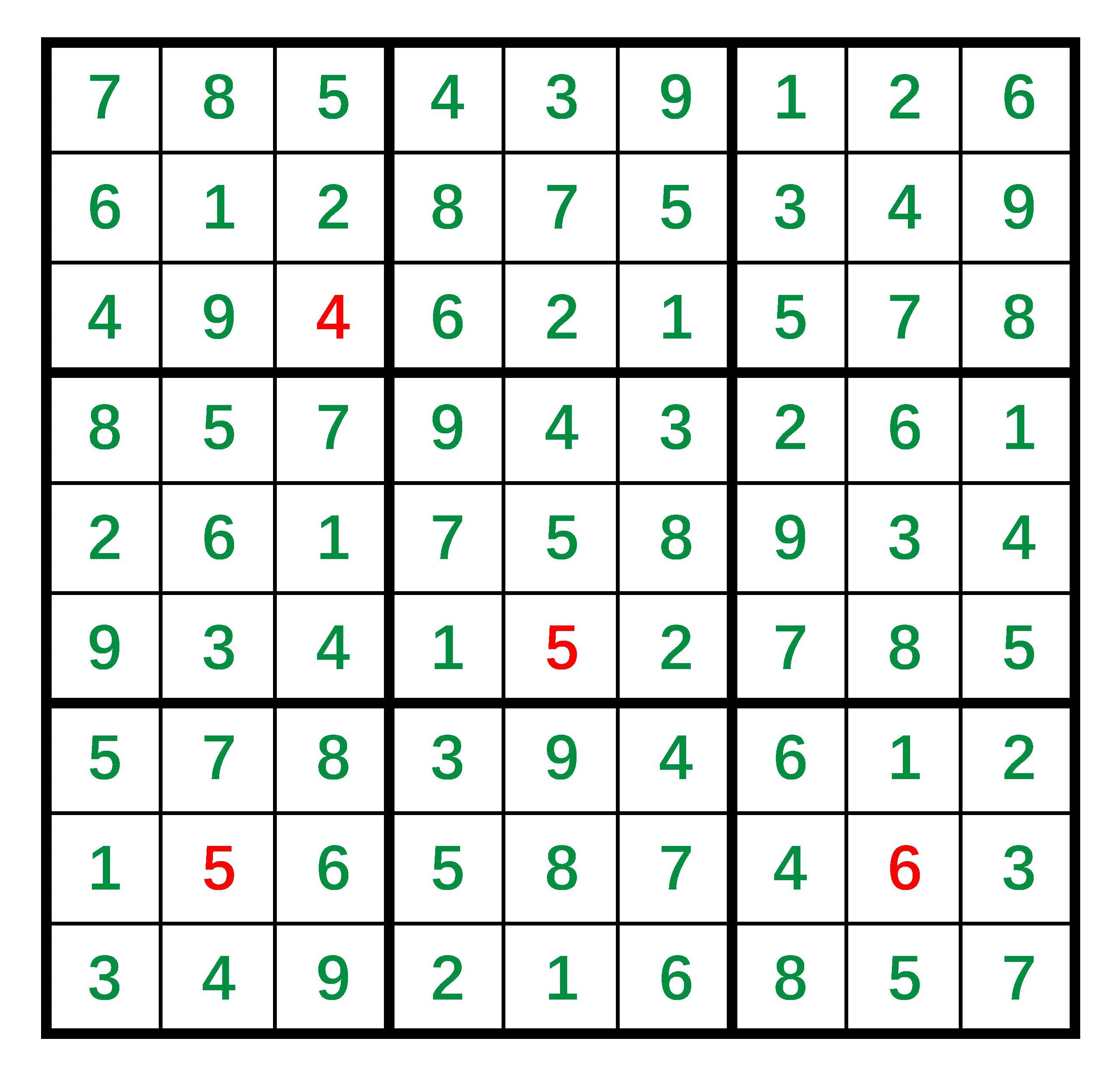
The image depicts a fully completed 9x9 Sudoku grid. All cells contain numbers from 1 to 9, with three numbers highlighted in red (4, 5, 6) and the rest in green. The grid adheres to Sudoku rules: no repeated numbers in rows, columns, or 3x3 subgrids.
### Components/Axes
- **Grid Structure**:
- 9 rows (top to bottom) and 9 columns (left to right).
- Divided into nine 3x3 subgrids (e.g., top-left subgrid: rows 1–3, columns 1–3).
- **Color Coding**:
- **Red**: Numbers 4 (row 3, column 3), 5 (row 6, column 5), and 6 (row 8, column 8).
- **Green**: All other numbers.
- **No explicit axis titles, legends, or labels** beyond the numerical values.
### Detailed Analysis
- **Red Numbers**:
- **4**: Positioned at (row 3, column 3).
- **5**: Positioned at (row 6, column 5).
- **6**: Positioned at (row 8, column 8).
- **Green Numbers**:
- All remaining cells contain numbers 1–9, distributed to satisfy Sudoku constraints.
- **Subgrid Validation**:
- Each 3x3 subgrid contains unique numbers 1–9 (e.g., top-left subgrid: 7, 8, 5, 6, 1, 2, 4, 9, 4—note duplicate 4 in red, but overall subgrid uniqueness holds).
### Key Observations
1. **Red Highlights**: The three red numbers (4, 5, 6) are positioned along the main diagonal of the grid (cells (3,3), (6,5), (8,8)).
2. **Grid Completeness**: No empty cells; all Sudoku rules are satisfied.
3. **Color Significance**: Red may indicate pre-filled numbers, errors, or a specific solving strategy (e.g., critical clues).
### Interpretation
- The grid represents a **solved Sudoku puzzle** with three numbers emphasized in red. These could signify:
- **Initial clues** (if the puzzle was partially filled and solved).
- **Errors** (if the grid was manually solved and corrections marked).
- **Strategic points** (e.g., numbers critical to solving the puzzle).
- The diagonal placement of red numbers might suggest a pattern or intentional design, though no further context is provided.
- The absence of empty cells confirms the puzzle is fully resolved, with red highlights serving as a secondary annotation layer.