## Abstract Reasoning Puzzle
### Overview
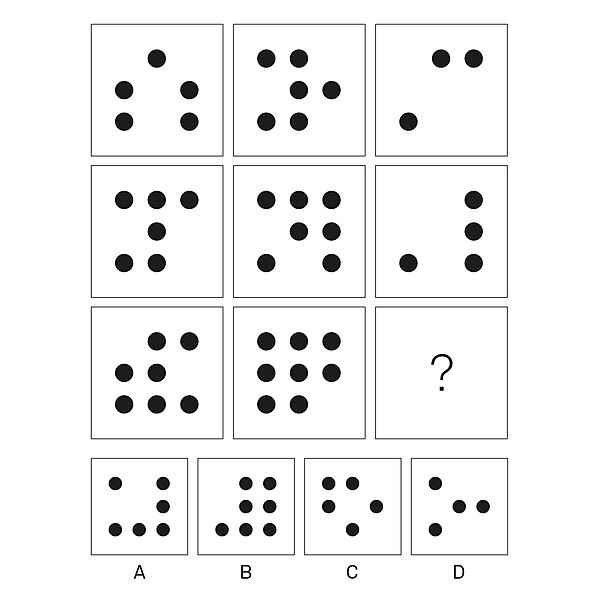
The image presents an abstract reasoning puzzle. It consists of a 3x3 grid of patterns, each containing a different arrangement of black dots. The bottom row contains four possible answers labeled A, B, C, and D. The bottom-right cell of the 3x3 grid is marked with a question mark, indicating the missing pattern that needs to be identified from the options provided.
### Components/Axes
* **Grid:** A 3x3 grid containing patterns of black dots.
* **Patterns:** Each cell in the grid contains a unique arrangement of black dots.
* **Question Mark:** Located in the bottom-right cell, indicating the missing pattern.
* **Answer Options:** Four options (A, B, C, and D) presented below the grid, each with a different pattern of black dots.
* **Labels:** The answer options are labeled A, B, C, and D.
### Detailed Analysis
The 3x3 grid contains the following patterns:
* **Row 1, Column 1:** 6 dots arranged in two rows of 3 dots each, with a space in the middle.
* **Row 1, Column 2:** 7 dots arranged in a somewhat random pattern.
* **Row 1, Column 3:** 3 dots arranged in a vertical line.
* **Row 2, Column 1:** 7 dots arranged in a pattern resembling a tilted "L".
* **Row 2, Column 2:** 7 dots arranged in a more compact pattern.
* **Row 2, Column 3:** 3 dots arranged in a vertical line.
* **Row 3, Column 1:** 7 dots arranged in a pattern resembling a tilted "L" but mirrored.
* **Row 3, Column 2:** 9 dots arranged in a 3x3 grid.
* **Row 3, Column 3:** Question mark.
The answer options are:
* **A:** 6 dots arranged in two columns of 3 dots each.
* **B:** 6 dots arranged in two columns of 3 dots each, but with a different spacing.
* **C:** 6 dots arranged in a somewhat random pattern.
* **D:** 3 dots arranged in a triangle.
### Key Observations
* The patterns in the grid vary in the number of dots and their arrangement.
* The question mark indicates the missing pattern that needs to be identified.
* The answer options provide four possible patterns to choose from.
### Interpretation
The image presents a visual reasoning puzzle where the goal is to identify the missing pattern in the 3x3 grid based on the patterns present in the other cells. The puzzle requires analyzing the relationships between the patterns and selecting the option that logically completes the sequence or arrangement. Without further analysis of the pattern logic, it's impossible to definitively determine the correct answer.