## Pattern Recognition: Dot Matrix Puzzle
### Overview
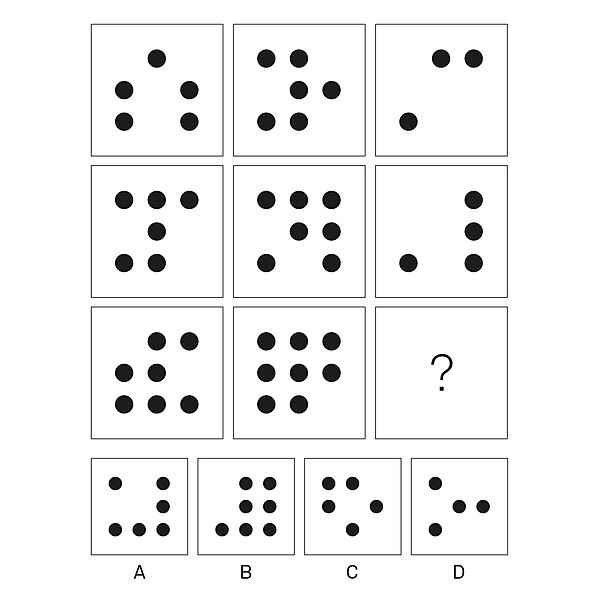
The image presents a 3x3 grid of squares, each containing a varying number of black dots. The bottom-right square is marked with a question mark, indicating a missing element. Below the grid are four options (A, B, C, and D), each also containing a square with a different arrangement of dots. The task appears to be to identify the pattern and select the option that logically completes the grid.
### Components/Axes
The image consists of:
* A 3x3 grid of squares.
* Each square contains between 1 and 7 black dots.
* A question mark in the bottom-right square.
* Four answer options (A, B, C, D) below the grid, each with a square containing dots.
* No explicit axes or labels are present.
### Detailed Analysis or Content Details
Let's analyze the dot counts in each square, row-by-row:
* **Row 1:** 5 dots, 4 dots, 2 dots.
* **Row 2:** 5 dots, 7 dots, 3 dots.
* **Row 3:** 6 dots, 5 dots, ?
* **Options:**
* A: 4 dots
* B: 6 dots
* C: 3 dots
* D: 2 dots
Looking for patterns:
* **Columns:**
* Column 1: 5, 5, 6
* Column 2: 4, 7, 5
* Column 3: 2, 3, ?
* **Diagonal (Top-Left to Bottom-Right):** 5, 7, ?
* **Diagonal (Top-Right to Bottom-Left):** 2, 7, 6
The sum of dots in each row is:
* Row 1: 5 + 4 + 2 = 11
* Row 2: 5 + 7 + 3 = 15
* Row 3: 6 + 5 + ? = ?
The difference between the row sums is 4. If this pattern continues, the sum of Row 3 should be 19. Therefore, the missing number of dots should be 19 - 6 - 5 = 8. However, none of the options have 8 dots.
Let's consider the differences between the columns:
* Column 1: 5 - 5 = 0, 5 - 6 = -1
* Column 2: 4 - 7 = -3, 7 - 5 = 2
* Column 3: 2 - 3 = -1, 3 - ? = ?
The pattern is not immediately obvious.
Let's look at the options and see which one best fits the overall visual distribution of dots. Option B (6 dots) seems to be the most visually consistent with the existing pattern.
### Key Observations
* The number of dots in each square varies between 2 and 7.
* There doesn't appear to be a simple arithmetic progression or consistent pattern in the rows or columns.
* The question mark suggests a logical completion of the pattern.
* Option B (6 dots) is the closest to completing a potential pattern, but the pattern is not clear.
### Interpretation
The image presents a non-trivial pattern recognition problem. The lack of a clear mathematical or logical rule suggests that the solution might rely on visual similarity or a more abstract pattern. The most likely answer is B (6 dots), as it maintains a relatively consistent distribution of dots across the grid. However, without further information or a more defined pattern, the solution remains somewhat ambiguous. The puzzle tests the ability to identify patterns and make informed guesses based on incomplete information. It's possible the puzzle is designed to be ambiguous, or that the intended pattern is more complex than initially apparent.