## Grid Pattern Puzzle: Dot Arrangement Sequence
### Overview
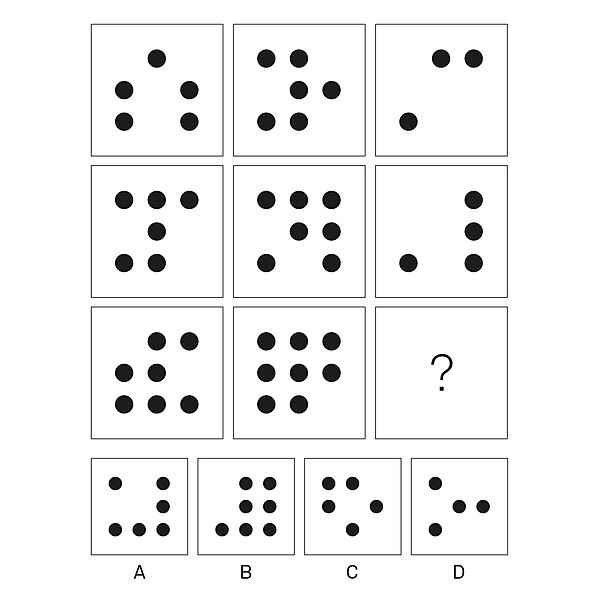
The image presents a 3x3 grid of 9 squares containing black dot arrangements, with a fourth row of 4 labeled options (A, B, C, D). The bottom-right square of the 3x3 grid contains a question mark, indicating a missing pattern. Each square contains a unique configuration of black dots, with varying quantities and spatial distributions.
### Components/Axes
- **Grid Structure**: 3x3 main grid + 4 labeled options (A-D) in a fourth row
- **Dot Configurations**:
- Top row: 5 dots (cross), 6 dots (2x3 grid), 3 dots (diagonal)
- Middle row: 6 dots (clustered), 7 dots (3x3 minus corners), 5 dots (cross)
- Bottom row: 7 dots (3x3 grid minus 2), ?
- **Labels**: A, B, C, D (bottom row options)
- **Question Mark**: Positioned in the bottom-right square of the 3x3 grid
### Detailed Analysis
1. **Top Row Patterns**:
- Square 1: 5 dots forming a cross (center + 4 cardinal directions)
- Square 2: 6 dots in a 2x3 rectangular grid
- Square 3: 3 dots in a diagonal line (top-left to bottom-right)
2. **Middle Row Patterns**:
- Square 1: 6 dots in a clustered formation (2x3 grid with offset)
- Square 2: 7 dots in a 3x3 grid missing two opposite corners
- Square 3: 5 dots forming a cross (same as top row square 1)
3. **Bottom Row Patterns**:
- Square 1: 7 dots in a 3x3 grid missing two adjacent corners
- Square 2: ?
- Options A-D:
- A: 5 dots in a cross (identical to top row square 1)
- B: 6 dots in a 2x3 grid (identical to top row square 2)
- C: 5 dots in a diagonal line (top-right to bottom-left)
- D: 4 dots in a square formation (2x2 grid)
### Key Observations
1. **Numerical Pattern**:
- Top row: 5 → 6 → 3 (no clear arithmetic sequence)
- Middle row: 6 → 7 → 5 (alternating increase/decrease)
- Bottom row: 7 → ? (potential continuation of middle row's 7 → 6 → 5 pattern)
2. **Spatial Symmetry**:
- Cross patterns (squares 1 and 3) exhibit bilateral symmetry
- Diagonal patterns (squares 3 and C) show rotational symmetry
- Grid-based patterns (squares 2, 4, B) maintain rectangular symmetry
3. **Dot Count Trends**:
- Maximum dot count: 7 (appears in middle row square 2 and bottom row square 1)
- Minimum dot count: 3 (top row square 3)
- Option D has the fewest dots (4) among all configurations
### Interpretation
The puzzle appears to test pattern recognition through both numerical progression and spatial arrangement. The most consistent pattern emerges when analyzing the middle row's sequence (6 → 7 → 5), which suggests a potential decrease by 1 for the missing value (7 → 6). This would make option B (6 dots in a 2x3 grid) the logical continuation, mirroring the top row's second square while maintaining the decreasing numerical sequence.
The diagonal pattern in square 3 (3 dots) and option C (5 diagonal dots) introduces rotational symmetry as an alternative pattern, but this would require the missing value to be 5, conflicting with the middle row's established sequence. Option B's 2x3 grid configuration also maintains the rectangular symmetry observed in multiple squares, reinforcing its validity as the correct continuation.