## Flowchart: Question-Answering System with Language Model
### Overview
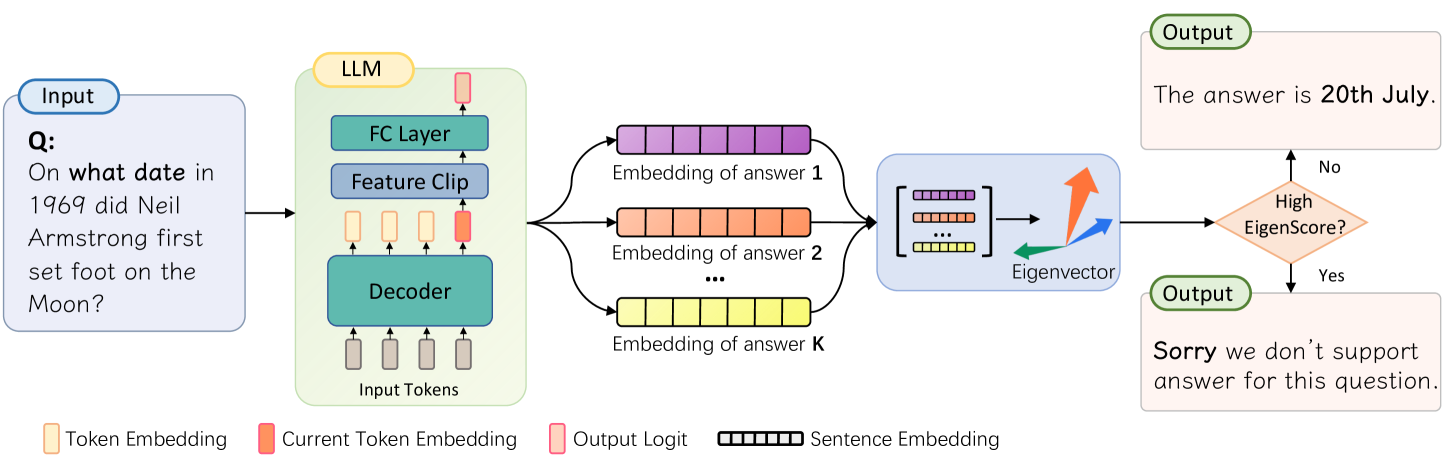
The image depicts a technical workflow for a question-answering system using a language model (LLM). It illustrates how input tokens are processed through a decoder architecture, generates candidate answer embeddings, and uses an eigenvector-based scoring mechanism to select the final output. The system includes confidence-based response validation.
### Components/Axes
1. **Input Section** (Leftmost block):
- Text: "On what date in 1969 did Neil Armstrong first set foot on the Moon?"
- Color coding:
- Yellow: Token Embedding
- Red: Current Token Embedding
- Pink: Output Logit
2. **LLM Processing Block** (Central):
- Components:
- FC Layer (Feature Clip)
- Decoder
- Input Tokens: Represented as vertical bars with color gradients
- Output: Three answer embeddings (purple, orange, yellow) labeled "Embedding of answer 1", "Embedding of answer 2", ..., "Embedding of answer K"
3. **Eigenvector Processing** (Middle-right):
- Input: Matrix of answer embeddings
- Output: Eigenvector with directional arrows (red for positive, blue for negative)
4. **Output Section** (Rightmost):
- Decision diamond: "High EigenScore?"
- Two possible outputs:
- "The answer is 20th July."
- "Sorry we don't support answer for this question."
### Detailed Analysis
- **Token Processing**: Input tokens are color-coded (yellow for embeddings, red for current token) and fed into the LLM's decoder architecture.
- **Answer Generation**: The decoder produces K candidate answer embeddings, visualized as horizontal bars with gradient colors.
- **Eigenvector Analysis**: The eigenvector component processes embeddings through a matrix operation, with directional arrows indicating vector relationships.
- **Confidence Threshold**: A binary decision node evaluates the EigenScore to determine output validity.
### Key Observations
1. The system uses a confidence threshold (EigenScore) to filter unsupported answers.
2. Color coding distinguishes different processing stages:
- Yellow/Red: Input token representations
- Purple/Orange/Yellow: Answer embeddings
- Pink: Output logits
3. The eigenvector component suggests a mathematical approach to answer selection.
4. The flowchart implies a probabilistic or vector-based similarity matching mechanism.
### Interpretation
This system demonstrates a hybrid approach combining:
1. **Neural Language Modeling**: For answer generation through token embeddings and decoder architecture
2. **Linear Algebra**: Using eigenvectors to analyze answer embeddings
3. **Confidence Scoring**: Implementing a threshold mechanism for response validation
The eigenvector-based scoring suggests the system measures answer relevance through vector space relationships, potentially identifying the most semantically similar answer to the question. The confidence threshold indicates an awareness of answer reliability, preventing responses to unsupported queries. The color-coded visualization aids in understanding the multi-stage processing pipeline from raw input to final output.