## Diagram: Kernel Synchronization Comparison
### Overview
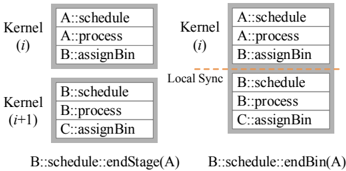
This image is a technical diagram illustrating two different approaches to managing kernel operations across consecutive iterations, `Kernel (i)` and `Kernel (i+1)`. It compares a scenario where kernel operations are distinct and separated (left side) with a scenario where they are integrated through a "Local Sync" mechanism (right side), highlighting the impact on specific scheduling events.
### Components/Labels
The diagram is structured into two main vertical sections, left and right, each depicting a different operational model.
**Left Section:**
* **Top Block:** Labeled "Kernel (i)" on its left side. This block has a light grey background and a dark grey border, containing three lines of text:
* "A::schedule"
* "A::process"
* "B::assignBin"
* **Bottom Block:** Labeled "Kernel (i+1)" on its left side. This block also has a light grey background and a dark grey border, positioned directly below the "Kernel (i)" block. It contains three lines of text:
* "B::schedule"
* "B::process"
* "C::assignBin"
* **Bottom Text (Left):** Located below the "Kernel (i+1)" block, the text reads: "B::schedule::endStage(A)"
**Right Section:**
* **Combined Block:** This section features a single, taller block with a light grey background and a dark grey border, vertically divided by a dashed orange line.
* **Label:** "Kernel (i)" is positioned to the left of the upper part of this combined block, at the same vertical level as the "Kernel (i)" label on the left side.
* **Upper Part Content:** Contains the same three lines of text as the "Kernel (i)" block on the left:
* "A::schedule"
* "A::process"
* "B::assignBin"
* **Separator:** A dashed orange horizontal line separates the upper and lower parts of the combined block.
* **Separator Label:** "Local Sync" is positioned to the left of the dashed orange line.
* **Lower Part Content:** Contains the same three lines of text as the "Kernel (i+1)" block on the left:
* "B::schedule"
* "B::process"
* "C::assignBin"
* **Bottom Text (Right):** Located below the combined block, the text reads: "B::schedule::endBin(A)"
### Detailed Analysis
The diagram presents two distinct states or execution models.
**Left Side (Separate Kernels):**
This side shows `Kernel (i)` and `Kernel (i+1)` as two distinct, sequential execution units.
* `Kernel (i)` executes tasks `A::schedule`, `A::process`, and `B::assignBin`.
* Following `Kernel (i)`, `Kernel (i+1)` executes tasks `B::schedule`, `B::process`, and `C::assignBin`.
* The event associated with this model is `B::schedule::endStage(A)`, suggesting that the `B::schedule` operation completes a "stage" related to `A` in this sequential or coarse-grained synchronization model.
**Right Side (Local Sync):**
This side shows `Kernel (i)` and `Kernel (i+1)` operations integrated into a single, continuous block, facilitated by a "Local Sync".
* The upper part of the block, implicitly `Kernel (i)`, contains `A::schedule`, `A::process`, and `B::assignBin`.
* A "Local Sync" operation, indicated by the dashed orange line, occurs after `B::assignBin` from `Kernel (i)`.
* Immediately following the "Local Sync", the lower part of the block, implicitly `Kernel (i+1)`, begins executing `B::schedule`, `B::process`, and `C::assignBin`.
* The event associated with this model is `B::schedule::endBin(A)`, suggesting that the `B::schedule` operation completes a "bin" related to `A` under this local synchronization model.
### Key Observations
* The content of the kernel operations (`A::schedule`, `A::process`, `B::assignBin`, `B::schedule`, `B::process`, `C::assignBin`) remains identical in both scenarios.
* The primary structural difference is the explicit separation of `Kernel (i)` and `Kernel (i+1)` on the left versus their integration via a "Local Sync" on the right.
* The "Local Sync" on the right side effectively merges the execution contexts of `Kernel (i)` and `Kernel (i+1)` into a single, continuous flow, with a synchronization point in between.
* The associated event changes from `B::schedule::endStage(A)` in the separated model to `B::schedule::endBin(A)` in the local sync model. This indicates a change in the granularity or type of completion event for `B::schedule` with respect to `A`.
### Interpretation
This diagram illustrates a conceptual shift in how kernel operations across different iterations (`i` and `i+1`) are synchronized and managed.
The **left side** represents a more traditional or coarse-grained approach. `Kernel (i)` completes all its tasks, and then `Kernel (i+1)` begins. The event `B::schedule::endStage(A)` suggests that the `B::schedule` operation, when it eventually runs in `Kernel (i+1)`, marks the completion of a larger "stage" that might encompass all operations related to `A` from `Kernel (i)` and potentially other preceding tasks. This implies a full barrier or global synchronization between kernel iterations.
The **right side** introduces a "Local Sync" mechanism. This suggests an optimization where the boundary between `Kernel (i)` and `Kernel (i+1)` is not a full global barrier but a more localized synchronization point. After `B::assignBin` from `Kernel (i)`, a "Local Sync" occurs, allowing `B::schedule` from `Kernel (i+1)` to begin immediately. The change in the associated event to `B::schedule::endBin(A)` is crucial. It implies that with "Local Sync", `B::schedule` can complete a smaller, more granular unit of work, a "bin," related to `A`, rather than waiting for a full "stage" to conclude. This could lead to:
* **Improved Latency:** Tasks from `Kernel (i+1)` can start sooner, without waiting for the entire `Kernel (i)` to finish.
* **Better Resource Utilization:** Resources might be released and re-allocated more quickly, or tasks can be pipelined more effectively.
* **Finer-grained Control:** The "Local Sync" allows for more precise control over dependencies between specific tasks across kernel iterations.
In essence, the diagram demonstrates how a "Local Sync" can transform a sequential, stage-based execution model into a more integrated, bin-based execution model, likely for performance or efficiency gains in a system where `Kernel (i)` and `Kernel (i+1)` represent successive computational steps. The specific functions `A::schedule`, `A::process`, `B::assignBin`, `B::schedule`, `B::process`, and `C::assignBin` represent abstract operations within these kernels, and their interaction with `A` and `B` highlights the dependencies being managed.