## Diagram: Kernel Synchronization Flowchart
### Overview
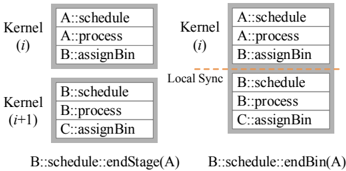
The image is a technical diagram illustrating a synchronization process between two computational kernels, labeled Kernel (i) and Kernel (i+1). It depicts two states: an initial state on the left and a synchronized state on the right, connected by a "Local Sync" operation. The diagram uses a flowchart style with rectangular boxes representing kernels and their internal task lists, connected by directional arrows.
### Components/Axes
The diagram is composed of the following elements:
1. **Kernel Boxes:** Four rectangular boxes, each containing a title and a list of three tasks.
* **Top-Left Box:** Title: `Kernel (i)`. Tasks: `A::schedule`, `A::process`, `B::assignBin`.
* **Bottom-Left Box:** Title: `Kernel (i+1)`. Tasks: `B::schedule`, `B::process`, `C::assignBin`.
* **Top-Right Box:** Title: `Kernel (i)`. Tasks: `A::schedule`, `A::process`, `B::assignBin`.
* **Bottom-Right Box:** Title: `Kernel (i+1)`. Tasks: `B::schedule`, `B::process`, `B::assignBin`.
2. **Arrows and Labels:**
* A vertical arrow points downward from the top-left box to the bottom-left box.
* A horizontal arrow labeled **"Local Sync"** points from the left side of the diagram to the right side.
* A vertical arrow points downward from the top-right box to the bottom-right box.
3. **Footer Labels:**
* Below the left column: `B::schedule::endStage(A)`
* Below the right column: `B::schedule::endBin(A)`
### Detailed Analysis
The diagram presents a before-and-after view of a kernel synchronization event.
* **Initial State (Left Column):**
* Kernel (i) is executing tasks related to entity `A` (`A::schedule`, `A::process`) and a task for entity `B` (`B::assignBin`).
* Kernel (i+1) is executing tasks for entity `B` (`B::schedule`, `B::process`) and a task for entity `C` (`C::assignBin`).
* The label `B::schedule::endStage(A)` suggests that the `B::schedule` task in Kernel (i+1) has a dependency or synchronization point with the completion of a stage related to entity `A` from Kernel (i).
* **Synchronization Action:** The "Local Sync" arrow indicates a synchronization barrier or data exchange operation between the two kernels.
* **Synchronized State (Right Column):**
* Kernel (i)'s task list remains unchanged.
* Kernel (i+1)'s task list has changed: the final task is now `B::assignBin` instead of `C::assignBin`.
* The label `B::schedule::endBin(A)` now appears, indicating the synchronization point has advanced or changed context.
### Key Observations
1. **Task Modification:** The primary change after synchronization is in Kernel (i+1). The task `C::assignBin` is replaced with `B::assignBin`. This implies that the synchronization operation resulted in Kernel (i+1) receiving a new task (`B::assignBin`) related to entity `B`, potentially from Kernel (i), and its previous task for entity `C` was either completed, deferred, or replaced.
2. **Synchronization Point Evolution:** The footer label changes from `endStage(A)` to `endBin(A)`. This suggests the synchronization is tied to the lifecycle of entity `A`, progressing from a "stage" completion to a "bin" completion.
3. **Task Naming Convention:** Tasks follow a `Entity::Action` format (e.g., `A::schedule`). The entities involved are `A`, `B`, and `C`. Kernel (i) handles `A` and `B`, while Kernel (i+1) initially handles `B` and `C`.
### Interpretation
This diagram likely illustrates a **task dependency and handoff mechanism in a parallel or multi-kernel computing system**, such as a GPU warp scheduler or a distributed processing pipeline.
* **What it demonstrates:** It shows how work items (represented by entities A, B, C) are managed across different execution units (kernels). Kernel (i) appears to be a producer or upstream processor for entity `B`, while Kernel (i+1) is a consumer or downstream processor.
* **Relationship between elements:** The "Local Sync" is the critical operation that resolves dependencies. Before sync, Kernel (i+1) is ready to work on entity `C` but is waiting (`endStage(A)`) for a signal from Kernel (i)'s work on `A`. After the sync, Kernel (i) has provided the necessary data or signal for entity `B`, allowing Kernel (i+1) to update its work queue to process `B::assignBin` and its wait condition advances to `endBin(A)`.
* **Notable anomaly/pattern:** The replacement of `C::assignBin` with `B::assignBin` is the key event. This indicates a dynamic task queue where kernels can receive new work items from other kernels upon synchronization, rather than having a static, pre-assigned list of tasks. The system appears designed for flexible, dependency-driven task scheduling.