## Flowchart: Apply Embedding to kv
### Overview
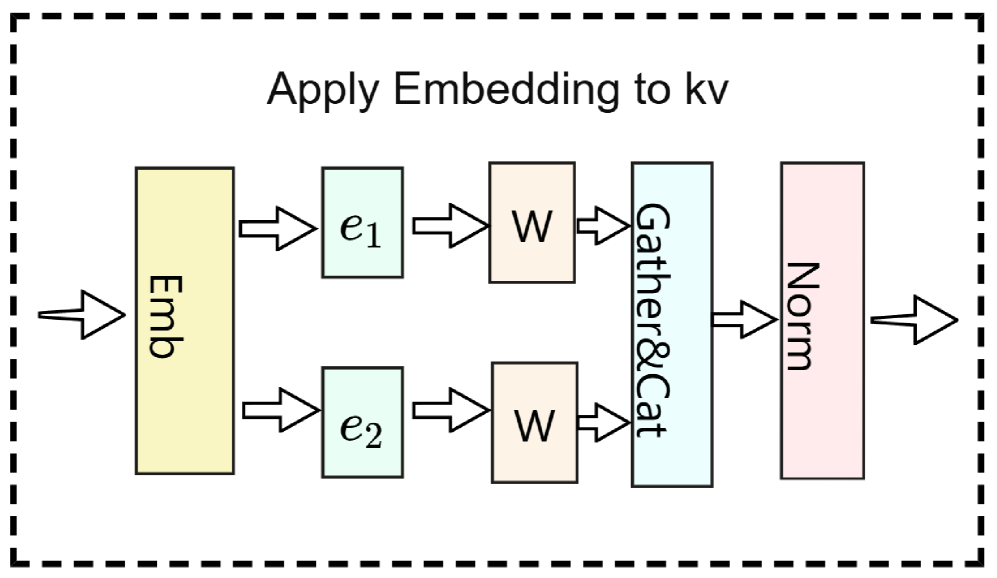
The diagram illustrates a sequential data processing pipeline for applying embeddings to a knowledge vector (kv). It depicts a structured workflow with six key components connected by directional arrows, representing the flow of data transformations.
### Components/Axes
1. **Input**:
- **Emb** (embedding layer) - Yellow box on the far left
2. **Processing Steps**:
- **e1** (embedding output 1) - Light blue box
- **W** (weight matrix) - Peach box (appears twice)
- **Gather&Cat** (gather and concatenate) - Light blue box
- **Norm** (normalization) - Pink box
3. **Output**:
- Final normalized vector (arrow exiting right side)
### Detailed Analysis
1. **Flow Sequence**:
- **Emb** → **e1** → **W** → **Gather&Cat** → **Norm**
- **Emb** → **e2** → **W** → **Gather&Cat** → **Norm**
2. **Key Operations**:
- **W**: Weight matrix multiplication applied to both e1 and e2
- **Gather&Cat**: Combines transformed embeddings (e1*W and e2*W)
- **Norm**: Final normalization step
### Key Observations
- Dual-path processing: Two parallel embedding streams (e1 and e2) converge after weight matrix application
- Normalization is the final processing step before output
- No numerical values or quantitative metrics present in the diagram
### Interpretation
This diagram represents a typical neural network architecture component for knowledge vector processing. The workflow suggests:
1. **Embedding Layer**: Converts input features into dense vector representations (e1 and e2)
2. **Weight Transformation**: Applies learned parameters (W) to embeddings
3. **Feature Fusion**: Combines transformed embeddings through concatenation
4. **Normalization**: Ensures output vector has unit magnitude, crucial for stable training dynamics
The architecture implies a Siamese-like network design where two embedding paths are processed identically before fusion, commonly used in contrastive learning tasks. The explicit normalization step indicates attention to gradient stability and output scale consistency.