## Screenshot: 3D Simulation Environment Interface
### Overview
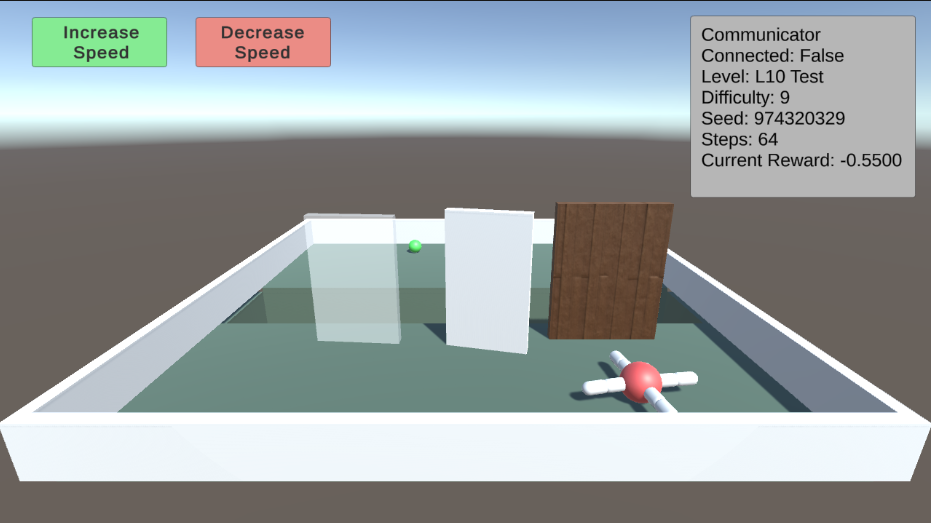
The image depicts a 3D simulation environment interface with interactive elements and technical status indicators. The scene includes a rectangular white box containing geometric panels, a molecular model, and a green sphere. UI elements include speed control buttons and a status panel displaying simulation parameters.
### Components/Axes
1. **UI Elements**:
- **Top-left**: Green button labeled "Increase Speed"
- **Top-center**: Red button labeled "Decrease Speed"
- **Top-right**: Status panel with technical details:
- "Communicator Connected: False"
- "Level: L10 Test"
- "Difficulty: 9"
- "Seed: 974320329"
- "Steps: 64"
- "Current Reward: -0.5500"
2. **3D Environment**:
- **Main Box**: White rectangular enclosure with green floor
- **Panels**:
- Left: Transparent glass panel
- Center: White opaque panel
- Right: Brown wooden panel
- **Objects**:
- Green sphere (top-left interior)
- Propane molecule model (bottom-right interior)
### Detailed Analysis
- **Status Panel**:
- Simulation is disconnected from a communicator
- Level identifier "L10 Test" suggests a 10th-level test scenario
- Difficulty 9/10 indicates high complexity
- Seed value 974320329 implies reproducibility parameters
- 64 steps completed with negative reward (-0.5500) suggests suboptimal performance
- **3D Elements**:
- Panels arranged sequentially from left (transparent) to right (brown)
- Molecular model (C₃H₈) positioned in bottom-right quadrant
- Green sphere located near top-left interior corner
### Key Observations
1. Color-coded UI: Green (increase) and red (decrease) buttons follow standard color conventions
2. Negative reward value (-0.5500) indicates current task failure state
3. Molecular model placement suggests chemistry-related simulation objectives
4. Panel arrangement creates spatial progression from transparent to opaque
### Interpretation
This appears to be a reinforcement learning environment for testing autonomous agents. The negative reward (-0.5500) and high difficulty (9/10) suggest the agent is struggling with navigation or object interaction tasks. The propane molecule model implies potential chemical manipulation objectives, while the panel arrangement may represent environmental obstacles. The disconnected communicator status indicates this is likely a local test environment rather than a networked system. The seed value enables experiment reproducibility, while the step count (64) provides progress tracking within the simulation episode.