## Chart/Diagram Type: Four Diagrams Illustrating Learning Concepts
### Overview
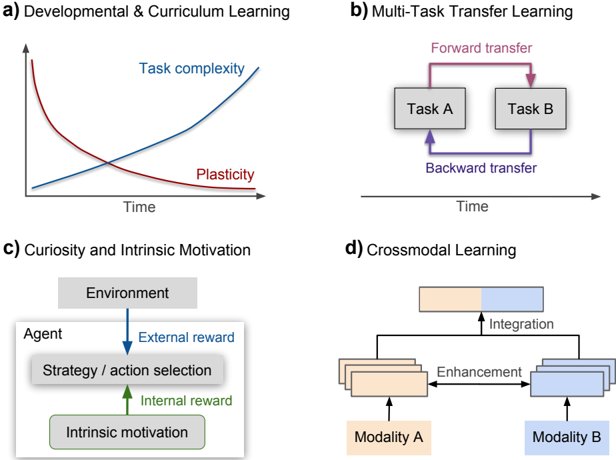
The image presents four diagrams illustrating different learning concepts: Developmental & Curriculum Learning, Multi-Task Transfer Learning, Curiosity and Intrinsic Motivation, and Crossmodal Learning. Each diagram uses a combination of graphs, flowcharts, and conceptual models to explain the respective learning process.
### Components/Axes
**a) Developmental & Curriculum Learning:**
* **Axes:**
* X-axis: Time
* Y-axis: Implicit, represents the level or degree of the plotted variables.
* **Data Series:**
* Task complexity (blue): Starts at a low level and increases over time.
* Plasticity (red): Starts at a high level and decreases over time.
**b) Multi-Task Transfer Learning:**
* **Elements:**
* Task A: A rectangular box representing a task.
* Task B: A rectangular box representing a task.
* Forward transfer: A purple arrow indicating knowledge transfer from Task A to Task B.
* Backward transfer: A blue arrow indicating knowledge transfer from Task B to Task A.
* X-axis: Time
**c) Curiosity and Intrinsic Motivation:**
* **Elements:**
* Environment: A rectangular box representing the external environment.
* Agent: A larger rectangular box containing the agent's internal processes.
* Strategy / action selection: A rectangular box within the Agent representing the decision-making process.
* Intrinsic motivation: A rectangular box representing the internal drive.
* External reward: A blue arrow pointing from the Environment to the Agent.
* Internal reward: A green arrow pointing from Intrinsic motivation to Strategy / action selection.
**d) Crossmodal Learning:**
* **Elements:**
* Modality A: A rectangular box representing one modality (e.g., visual).
* Modality B: A rectangular box representing another modality (e.g., auditory).
* Integration: A rectangular box representing the combined information from both modalities.
* Enhancement: Arrows indicating the mutual enhancement between Modality A and Modality B.
### Detailed Analysis
**a) Developmental & Curriculum Learning:**
* The "Task complexity" line starts at a low value (approximately 10% of the Y-axis) and increases non-linearly, showing a steeper initial increase that gradually slows down. It ends at a high value (approximately 80% of the Y-axis).
* The "Plasticity" line starts at a high value (approximately 90% of the Y-axis) and decreases non-linearly, showing a rapid initial decrease that gradually slows down. It ends at a low value (approximately 20% of the Y-axis).
* The two lines intersect at approximately 40% of the X-axis, where both "Task complexity" and "Plasticity" have a value of approximately 50% of the Y-axis.
**b) Multi-Task Transfer Learning:**
* The diagram illustrates the concept of transfer learning between two tasks.
* "Forward transfer" indicates that learning Task A helps in learning Task B.
* "Backward transfer" indicates that learning Task B helps in learning Task A.
**c) Curiosity and Intrinsic Motivation:**
* The diagram illustrates how an agent interacts with the environment and receives both external and internal rewards.
* The "Environment" provides "External reward" to the "Agent".
* The "Agent" uses "Strategy / action selection" based on both "External reward" and "Internal reward".
* "Intrinsic motivation" provides "Internal reward" to the "Strategy / action selection" process.
**d) Crossmodal Learning:**
* The diagram illustrates how information from different modalities is integrated and enhanced.
* "Modality A" and "Modality B" represent different sensory inputs.
* "Enhancement" indicates that each modality improves the processing of the other.
* "Integration" represents the combined information from both modalities.
### Key Observations
* **Developmental & Curriculum Learning:** As time progresses, task complexity increases while plasticity decreases.
* **Multi-Task Transfer Learning:** Knowledge can be transferred bidirectionally between tasks.
* **Curiosity and Intrinsic Motivation:** Both external and internal rewards drive the agent's learning process.
* **Crossmodal Learning:** Integrating information from different modalities enhances learning.
### Interpretation
The four diagrams illustrate different aspects of learning. The first diagram shows how task complexity and plasticity change over time during development and curriculum learning. The second diagram demonstrates how knowledge can be transferred between multiple tasks. The third diagram highlights the role of curiosity and intrinsic motivation in driving learning. The fourth diagram illustrates how integrating information from different modalities can enhance learning. Together, these diagrams provide a comprehensive overview of various learning concepts.