TECHNICAL ASSET FINGERPRINT
68b78ec6a93f7bf57ccfffd4
Click to view fullscreen
Press ESC or click to close
FOUND IN PAPERS
EXPERT: healer-alpha-free VERSION 1
RUNTIME: free/openrouter/healer-alpha
INTEL_VERIFIED
## Composite Diagram: Four Concepts in Machine Learning & AI
### Overview
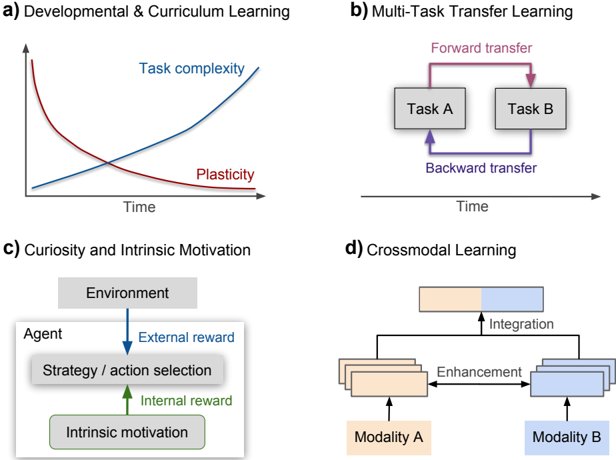
The image is a composite of four distinct conceptual diagrams, labeled a) through d), each illustrating a different principle or framework in artificial intelligence and machine learning. The diagrams are arranged in a 2x2 grid. All text is in English.
### Components/Axes
The image is segmented into four quadrants:
* **Top-Left (a):** A line graph titled "Developmental & Curriculum Learning".
* **Top-Right (b):** A flow diagram titled "Multi-Task Transfer Learning".
* **Bottom-Left (c):** A system diagram titled "Curiosity and Intrinsic Motivation".
* **Bottom-Right (d):** A structural diagram titled "Crossmodal Learning".
### Detailed Analysis
#### a) Developmental & Curriculum Learning
* **Type:** Line graph.
* **Axes:**
* **X-axis:** Labeled "Time". No numerical markers.
* **Y-axis:** Unlabeled, but represents magnitude or level.
* **Data Series & Trends:**
1. **Blue Line ("Task complexity"):** Starts low on the left and slopes upward to the right, indicating that task complexity increases over time.
2. **Red Line ("Plasticity"):** Starts high on the left and slopes downward to the right, indicating that plasticity (the capacity for change or learning) decreases over time.
* **Key Relationship:** The two lines intersect at a point roughly in the middle of the time axis. This suggests a trade-off: as an agent or system matures (time progresses), it can handle more complex tasks but becomes less adaptable.
#### b) Multi-Task Transfer Learning
* **Type:** Flow diagram with a temporal axis.
* **Components:**
* Two gray rectangular boxes labeled **"Task A"** and **"Task B"**.
* A horizontal line at the bottom labeled **"Time"**, indicating the sequence of learning.
* **Flow & Relationships:**
* A purple arrow labeled **"Forward transfer"** points from Task A to Task B, indicating knowledge learned from Task A is applied to facilitate learning Task B.
* A second purple arrow labeled **"Backward transfer"** points from Task B back to Task A, indicating that learning Task B can also refine or improve performance on the previously learned Task A.
* **Spatial Grounding:** The "Forward transfer" arrow is positioned above the "Backward transfer" arrow. The time axis implies Task A is learned before Task B.
#### c) Curiosity and Intrinsic Motivation
* **Type:** System/agent-environment interaction diagram.
* **Components & Text:**
* **Environment:** A gray box at the top.
* **Agent:** A larger containing box below the Environment.
* Inside the Agent:
* **"Strategy / action selection"**: A central gray box.
* **"Intrinsic motivation"**: A gray box at the bottom.
* **Reward Signals:**
* A blue arrow from Environment to Strategy/action selection labeled **"External reward"**.
* A green arrow from Intrinsic motivation to Strategy/action selection labeled **"Internal reward"**.
* **Flow:** The diagram shows that an agent's choice of action is driven by two reward sources: external rewards from the environment and internal rewards generated by its own intrinsic motivation (e.g., curiosity).
#### d) Crossmodal Learning
* **Type:** Structural/hierarchical diagram.
* **Components & Text:**
* **Inputs:** Two labels at the bottom: **"Modality A"** (orange background) and **"Modality B"** (blue background).
* **Processing Layers:** Above each modality label are stacked rectangles (3 for A, 4 for B), suggesting multiple features or layers of processing for each sensory input.
* **Operations:**
* A double-headed arrow between the two stacks of rectangles is labeled **"Enhancement"**, indicating that information from one modality can improve the representation of the other.
* Arrows from both stacks lead upward to a final combined rectangle, with the process labeled **"Integration"**.
* **Spatial Grounding:** The "Integration" box is at the top center. "Enhancement" is a bidirectional process occurring between the intermediate processing layers of the two modalities.
### Key Observations
1. **Temporal Themes:** Diagrams a) and b) explicitly incorporate a "Time" axis, framing learning as a process that unfolds and changes characteristics over duration.
2. **Trade-offs vs. Synergies:** Diagram a) highlights a fundamental trade-off (complexity vs. plasticity), while diagrams b) and d) emphasize synergistic benefits (transfer learning, crossmodal enhancement).
3. **Internal vs. External Drivers:** Diagram c) explicitly separates and connects internal cognitive drives (intrinsic motivation) with external environmental feedback (external reward).
4. **Abstraction Level:** All diagrams are high-level conceptual models. They describe *what* happens or *how* components relate, but not the specific algorithms or mathematical implementations.
### Interpretation
This composite image serves as a visual taxonomy of advanced learning paradigms that move beyond simple, isolated task training.
* **a) Developmental & Curriculum Learning** suggests that optimal learning schedules should match task difficulty to the learner's changing capacity, mirroring biological development. The decreasing plasticity curve implies that early learning phases are critical for establishing foundational knowledge.
* **b) Multi-Task Transfer Learning** argues against viewing tasks in isolation. The bidirectional arrows propose a virtuous cycle where learning is cumulative and recursive; knowledge is not just transferred forward but is also refined by subsequent experiences, leading to more robust and generalizable intelligence.
* **c) Curiosity and Intrinsic Motivation** provides a framework for autonomous exploration. It posits that for an agent to learn effectively in open-ended environments, it must generate its own goals (internal rewards) alongside pursuing external ones. This is key for developing proactive, rather than purely reactive, AI.
* **d) Crossmodal Learning** illustrates the principle that integrating information from multiple senses (e.g., vision and audio) leads to richer, more reliable representations than processing each in isolation. The "Enhancement" step is crucial—it implies the modalities don't just combine; they actively improve each other's signal quality before final integration.
**Collectively,** these diagrams outline a vision for more sophisticated AI systems: ones that learn sequentially and transfer knowledge (a, b), are driven by internal curiosity (c), and fuse multimodal data (d). They represent a shift from training on static datasets to building agents that learn dynamically, interactively, and holistically, much like biological intelligence.
DECODING INTELLIGENCE...