## Chart/Diagram Type: Learning Framework Components
### Overview
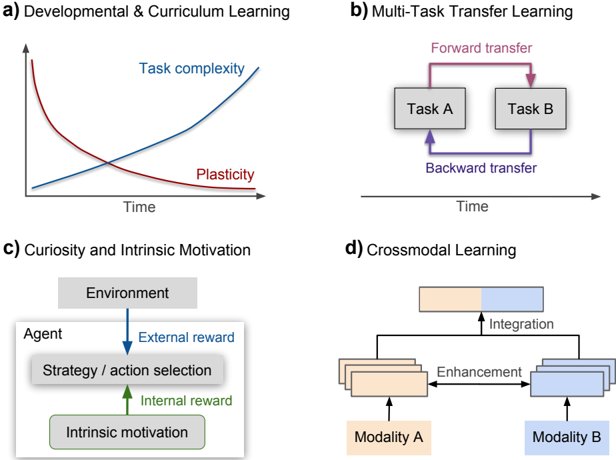
The image presents four interconnected diagrams illustrating different learning paradigms: Developmental & Curriculum Learning, Multi-Task Transfer Learning, Curiosity and Intrinsic Motivation, and Crossmodal Learning. Each section uses graphs, flowcharts, and labeled components to depict relationships between variables and processes.
---
### Components/Axes
#### a) Developmental & Curriculum Learning
- **Graph Type**: Line chart with two intersecting curves.
- **Axes**:
- X-axis: "Time" (horizontal, labeled at the bottom).
- Y-axis: Implicitly represents "Learning Metric" (no explicit label).
- **Lines**:
- **Blue Line**: "Task complexity" (increases over time).
- **Red Line**: "Plasticity" (decreases over time).
- **Key Features**:
- Intersection point where task complexity surpasses plasticity.
- No numerical values provided; trends are qualitative.
#### b) Multi-Task Transfer Learning
- **Diagram Type**: Bidirectional flowchart.
- **Components**:
- **Task A** and **Task B** (rectangular nodes).
- **Forward transfer** (pink arrow from Task A → Task B).
- **Backward transfer** (purple arrow from Task B → Task A).
- **Time Axis**: Horizontal line labeled "Time" at the bottom.
#### c) Curiosity and Intrinsic Motivation
- **Diagram Type**: Hierarchical flowchart.
- **Components**:
- **Environment** (top box).
- **Agent** (central box).
- **Strategy/action selection** (middle box).
- **External reward** (blue arrow from Strategy → Environment).
- **Intrinsic motivation** (green arrow from Strategy → Intrinsic motivation).
- Feedback loop: Intrinsic motivation → Strategy/action selection.
#### d) Crossmodal Learning
- **Diagram Type**: Modular flowchart.
- **Components**:
- **Modality A** and **Modality B** (separate boxes).
- **Integration** (central box connecting modalities).
- **Enhancement** (arrow from Integration → Modality A/B).
---
### Detailed Analysis
#### a) Developmental & Curriculum Learning
- **Trends**:
- Task complexity increases linearly over time (blue line).
- Plasticity decreases exponentially over time (red line).
- **Key Observation**:
- The intersection point suggests a critical timeframe where task demands outpace the system’s adaptability.
#### b) Multi-Task Transfer Learning
- **Flow**:
- Knowledge flows bidirectionally between Task A and Task B.
- Forward/backward transfer implies mutual reinforcement.
#### c) Curiosity and Intrinsic Motivation
- **Flow**:
- Environment → Agent → Strategy/action selection.
- External rewards (blue) and intrinsic motivation (green) drive strategy selection.
- Intrinsic motivation forms a self-sustaining loop.
#### d) Crossmodal Learning
- **Flow**:
- Integration of Modality A and B → Enhancement of both modalities.
- Suggests synergistic improvement through crossmodal interaction.
---
### Key Observations
1. **Inverse Relationship (a)**: Task complexity and plasticity are inversely related over time, highlighting a trade-off in learning systems.
2. **Bidirectional Transfer (b)**: Multi-task learning benefits from reciprocal knowledge exchange, unlike unidirectional curriculum learning.
3. **Intrinsic Loop (c)**: Intrinsic motivation acts as a self-reinforcing mechanism, reducing reliance on external rewards.
4. **Crossmodal Synergy (d)**: Integration enhances both modalities, emphasizing the value of multimodal data fusion.
---
### Interpretation
1. **Developmental Learning Trade-off**: As tasks grow complex, plasticity diminishes, suggesting diminishing returns in traditional learning curves. This aligns with biological aging or system saturation.
2. **Multi-Task Transfer Dynamics**: Bidirectional transfer implies that tasks are not isolated; learning in one domain can retroactively refine others, critical for efficient AI training.
3. **Intrinsic Motivation’s Role**: The green feedback loop underscores the importance of internal drives (e.g., curiosity) in sustaining learning without external incentives, a key insight for autonomous systems.
4. **Crossmodal Enhancement**: The integration-enhancement cycle suggests that combining modalities (e.g., vision + text) creates richer representations, improving generalization.
**Critical Insight**: These models collectively emphasize adaptability, interdependence, and self-sustaining mechanisms as pillars of advanced learning systems. The absence of numerical data in (a) and (b) limits quantitative analysis but reinforces conceptual understanding of learning paradigms.