## Diagram and Charts: Synaptic Weight Dynamics
### Overview
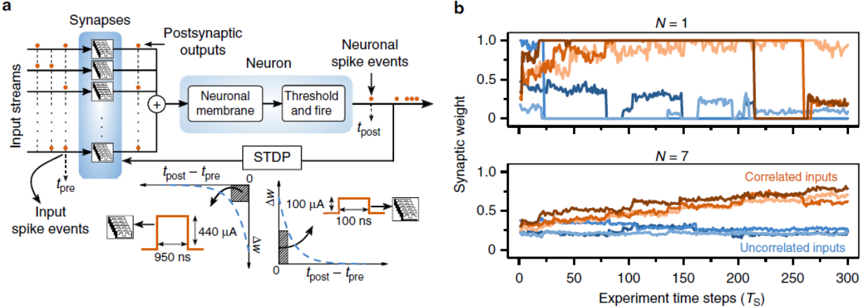
The image presents a diagram illustrating the process of spike-timing-dependent plasticity (STDP) in a neuron, coupled with two charts showing the synaptic weight changes over time under different input correlation conditions (N=1 and N=7).
### Components/Axes
**Part A: STDP Diagram**
* **Title:** Synapses, Neuron
* **Components:**
* **Input Streams:** Represented by vertical lines with dots, feeding into synapses.
* **Synapses:** An array of synaptic connections.
* **Postsynaptic Outputs:** The combined output from the synapses.
* **Neuronal Membrane:** A processing unit receiving the postsynaptic outputs.
* **Threshold and Fire:** A module that generates neuronal spike events when a threshold is reached.
* **Neuronal Spike Events:** Output of the neuron, represented by dots.
* **STDP (Spike-Timing-Dependent Plasticity):** A block representing the STDP mechanism.
* **tpre:** Time of the presynaptic spike.
* **tpost:** Time of the postsynaptic spike.
* **ΔW:** Change in synaptic weight.
* **STDP Timing Diagrams:**
* **Left Diagram:** Shows the change in synaptic weight (ΔW) as a function of the time difference (tpost - tpre). When tpost precedes tpre, there is a negative change in weight.
* Vertical axis: ΔW
* Horizontal axis: tpost - tpre
* **Right Diagram:** Shows the change in synaptic weight (ΔW) as a function of the time difference (tpost - tpre). When tpre precedes tpost, there is a positive change in weight.
* Vertical axis: ΔW
* Horizontal axis: tpost - tpre
* **Pulse Diagrams:**
* Left: A pulse with amplitude 440 μA and duration 950 ns.
* Right: A pulse with amplitude 100 μA and duration 100 ns.
**Part B: Synaptic Weight Charts**
* **Y-axis:** Synaptic weight (ranging from 0 to 1.0).
* **X-axis:** Experiment time steps (Ts) (ranging from 0 to 300).
* **Top Chart:** N = 1
* **Bottom Chart:** N = 7
* **Legend (Bottom Chart):**
* **Correlated inputs:** Represented by brown/orange lines.
* **Uncorrelated inputs:** Represented by blue lines.
### Detailed Analysis
**Part A: STDP Diagram**
* The diagram illustrates how input streams are processed through synapses, combined, and fed into a neuron. The neuron integrates these inputs via its neuronal membrane. If the integrated signal exceeds a threshold, the neuron fires, producing spike events. The STDP mechanism adjusts the synaptic weights based on the timing difference between pre- and postsynaptic spikes.
* The timing diagrams show the relationship between the timing difference (tpost - tpre) and the change in synaptic weight (ΔW). If the postsynaptic spike occurs before the presynaptic spike, the synaptic weight decreases (long-term depression, LTD). Conversely, if the presynaptic spike occurs before the postsynaptic spike, the synaptic weight increases (long-term potentiation, LTP).
**Part B: Synaptic Weight Charts**
* **Top Chart (N = 1):**
* The brown/orange lines representing correlated inputs show a high synaptic weight, close to 1.0, for most of the experiment. One line drops to 0 at approximately time step 250.
* The blue lines representing uncorrelated inputs show a low synaptic weight, close to 0, for most of the experiment. One line increases to approximately 0.75 at time step 50, then drops back to 0 at approximately time step 250.
* **Bottom Chart (N = 7):**
* The brown/orange lines representing correlated inputs show a gradual increase in synaptic weight over time, reaching values between 0.4 and 0.6 by the end of the experiment.
* The blue lines representing uncorrelated inputs show a low synaptic weight, remaining close to 0.2 for most of the experiment.
### Key Observations
* **STDP Mechanism:** The diagram clearly illustrates the STDP mechanism, showing how the timing of pre- and postsynaptic spikes influences synaptic weight changes.
* **Input Correlation Impact:** The charts demonstrate that correlated inputs lead to higher synaptic weights compared to uncorrelated inputs, especially when N = 7.
* **N = 1 vs. N = 7:** The synaptic weight dynamics differ significantly between N = 1 and N = 7. When N = 1, the synaptic weights tend to be more binary (either high or low), while when N = 7, the synaptic weights show a more gradual change over time.
### Interpretation
The data suggests that the STDP mechanism plays a crucial role in shaping synaptic connections based on the correlation of input signals. Correlated inputs strengthen synaptic connections, while uncorrelated inputs weaken them. The number of correlated inputs (N) influences the dynamics of synaptic weight changes. When N is small (N = 1), the synaptic weights exhibit more abrupt transitions, potentially indicating a winner-take-all scenario where only the most correlated input dominates. When N is larger (N = 7), the synaptic weights show a more gradual and distributed change, suggesting a more balanced integration of multiple correlated inputs. This highlights the importance of input correlation and the number of correlated inputs in shaping neuronal circuits and learning.