## Hierarchical Diagram: Box and Sub-Elements
### Overview
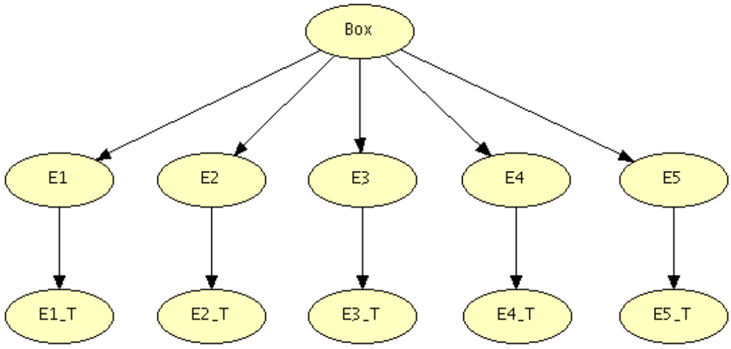
The image depicts a hierarchical tree structure with a root node labeled "Box" at the top. Five child nodes (E1, E2, E3, E4, E5) branch directly from "Box," each connected by downward-pointing arrows. Each of these child nodes has a subordinate node labeled with a "_T" suffix (E1_T, E2_T, E3_T, E4_T, E5_T), also connected by downward arrows. All nodes are oval-shaped and uniformly colored in light yellow.
### Components/Axes
- **Root Node**: "Box" (central top position).
- **First-Level Nodes**: E1, E2, E3, E4, E5 (arranged horizontally below "Box").
- **Second-Level Nodes**: E1_T, E2_T, E3_T, E4_T, E5_T (directly below their respective first-level nodes).
- **Arrows**: Black lines indicate hierarchical relationships (parent → child).
- **No numerical data, axes, legends, or color-coded categories are present.**
### Detailed Analysis
- **Textual Labels**: All nodes contain alphanumeric labels with no additional annotations or units.
- **Spatial Relationships**:
- "Box" is centrally positioned at the top.
- First-level nodes (E1–E5) are evenly spaced horizontally beneath "Box."
- Second-level nodes (E1_T–E5_T) align vertically below their parent nodes.
- **Flow Direction**: Unidirectional downward flow from "Box" to E1–E5, then to E1_T–E5_T.
### Key Observations
1. **Symmetry**: The structure is balanced, with equal spacing between sibling nodes.
2. **Uniformity**: All nodes share identical visual properties (color, shape, size).
3. **No Data Points**: No numerical values, percentages, or quantitative metrics are present.
4. **No Anomalies**: The diagram follows a strict hierarchical pattern without deviations.
### Interpretation
This diagram likely represents a **process flow**, **organizational structure**, or **decision tree** where:
- "Box" is the primary entity or starting point.
- E1–E5 represent intermediate stages or components.
- E1_T–E5_T denote transformed, targeted, or terminal states of their parent nodes (e.g., "E1" → "E1_T" could imply "Element 1" processed to "Element 1 Transformed").
The absence of numerical data or color-coding suggests the focus is on **logical relationships** rather than quantitative analysis. The "_T" suffix may indicate a transformation, target, or terminal state, but this requires contextual validation from the source material.