## Line Charts: Success Rate vs. Number of Actions under Varying Conditions
### Overview
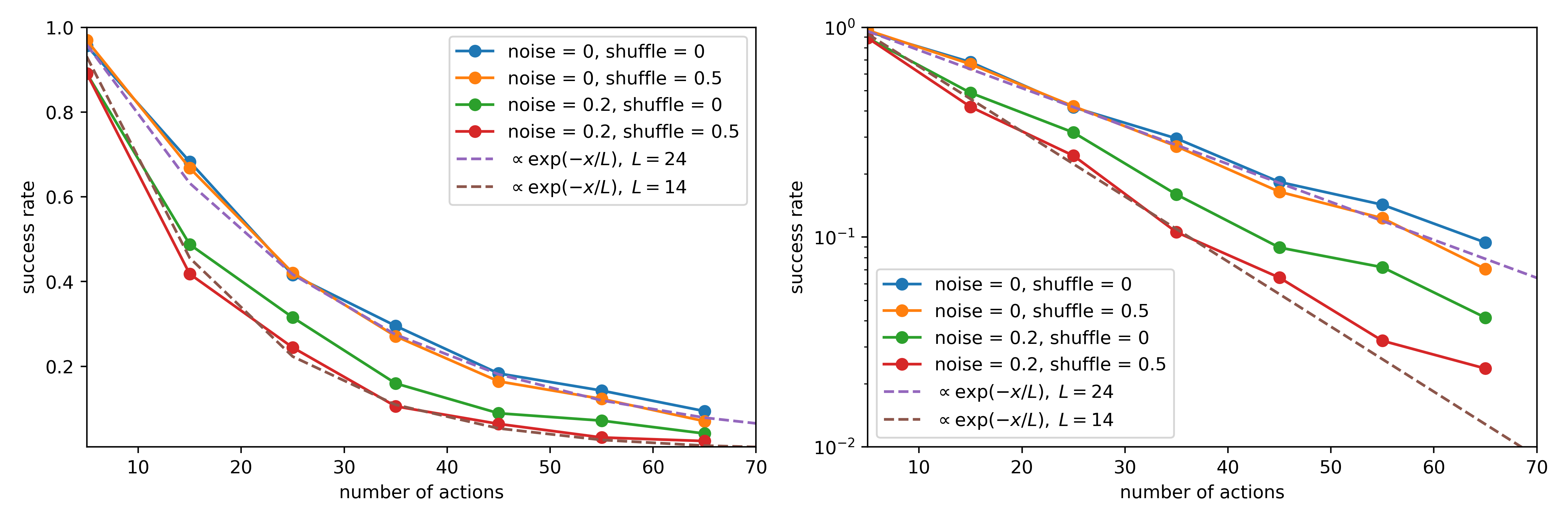
The image displays two line charts side-by-side, illustrating the "success rate" as a function of "number of actions" under different conditions of "noise" and "shuffle". Both charts present the same data series but differ in their Y-axis scaling: the left chart uses a linear scale, while the right chart uses a logarithmic scale. The charts also include two dashed lines representing exponential decay fits with different characteristic lengths (L).
### Components/Axes
**Common Elements (Both Charts):**
* **X-axis Label**: "number of actions"
* **X-axis Tick Markers**: 10, 20, 30, 40, 50, 60, 70. The data points are not aligned with these major tick marks but are positioned approximately at X-values of 7, 15, 25, 35, 45, 55, and 65.
* **Legend**: Located in the top-right quadrant of each chart, listing six data series with their corresponding colors and line styles.
* **Blue solid line with circular markers**: `noise = 0, shuffle = 0`
* **Orange solid line with circular markers**: `noise = 0, shuffle = 0.5`
* **Green solid line with circular markers**: `noise = 0.2, shuffle = 0`
* **Red solid line with circular markers**: `noise = 0.2, shuffle = 0.5`
* **Purple dashed line**: `∝ exp(-x/L), L = 24` (where '∝' means "proportional to")
* **Brown dashed line**: `∝ exp(-x/L), L = 14`
**Left Chart Specifics:**
* **Y-axis Label**: "success rate"
* **Y-axis Scale**: Linear, ranging from 0.0 to 1.0.
* **Y-axis Tick Markers**: 0.2, 0.4, 0.6, 0.8, 1.0.
**Right Chart Specifics:**
* **Y-axis Label**: "success rate"
* **Y-axis Scale**: Logarithmic, ranging from 10^-2 (0.01) to 10^0 (1.0).
* **Y-axis Tick Markers**: 10^-2, 10^-1, 10^0.
### Detailed Analysis
**Left Chart (Linear Y-axis)**
All data series show a decreasing trend in "success rate" as the "number of actions" increases.
* **Blue line (noise = 0, shuffle = 0)**: This line starts at a high success rate and decreases steadily.
* Data points (approx. X, Y): (7, 0.95), (15, 0.68), (25, 0.48), (35, 0.30), (45, 0.18), (55, 0.10), (65, 0.05).
* **Orange line (noise = 0, shuffle = 0.5)**: This line closely follows the blue line but is slightly below it, indicating a slightly lower success rate for the same number of actions.
* Data points (approx. X, Y): (7, 0.95), (15, 0.65), (25, 0.42), (35, 0.28), (45, 0.16), (55, 0.08), (65, 0.04).
* **Green line (noise = 0.2, shuffle = 0)**: This line shows a more rapid decrease in success rate compared to the blue and orange lines.
* Data points (approx. X, Y): (7, 0.90), (15, 0.48), (25, 0.28), (35, 0.15), (45, 0.08), (55, 0.04), (65, 0.02).
* **Red line (noise = 0.2, shuffle = 0.5)**: This line exhibits the steepest decline in success rate among the solid lines, consistently below the green line.
* Data points (approx. X, Y): (7, 0.88), (15, 0.42), (25, 0.20), (35, 0.10), (45, 0.05), (55, 0.02), (65, 0.01).
* **Purple dashed line (∝ exp(-x/L), L = 24)**: This line represents an exponential decay model. It starts around 0.9 and decays smoothly.
* Data points (approx. X, Y): (7, 0.90), (15, 0.68), (25, 0.48), (35, 0.34), (45, 0.24), (55, 0.17), (65, 0.12).
* **Brown dashed line (∝ exp(-x/L), L = 14)**: This line represents another exponential decay model with a shorter characteristic length, indicating a faster decay. It starts around 0.9 and decays more rapidly than the purple dashed line.
* Data points (approx. X, Y): (7, 0.90), (15, 0.50), (25, 0.28), (35, 0.16), (45, 0.09), (55, 0.05), (65, 0.03).
**Right Chart (Logarithmic Y-axis)**
All data series, when plotted on a logarithmic Y-axis, appear approximately linear, which is characteristic of exponential decay.
* **Blue line (noise = 0, shuffle = 0)**: This line appears mostly straight, indicating an exponential decay.
* Data points (approx. X, Y): (7, 0.95), (15, 0.68), (25, 0.48), (35, 0.30), (45, 0.18), (55, 0.10), (65, 0.05).
* **Orange line (noise = 0, shuffle = 0.5)**: This line also appears mostly straight and parallel to the blue line, but slightly below it.
* Data points (approx. X, Y): (7, 0.95), (15, 0.65), (25, 0.42), (35, 0.28), (45, 0.16), (55, 0.08), (65, 0.04).
* **Green line (noise = 0.2, shuffle = 0)**: This line is steeper than the blue and orange lines, indicating a faster exponential decay.
* Data points (approx. X, Y): (7, 0.90), (15, 0.48), (25, 0.28), (35, 0.15), (45, 0.08), (55, 0.04), (65, 0.02).
* **Red line (noise = 0.2, shuffle = 0.5)**: This line is the steepest among the solid lines, showing the most rapid exponential decay.
* Data points (approx. X, Y): (7, 0.88), (15, 0.42), (25, 0.20), (35, 0.10), (45, 0.05), (55, 0.02), (65, 0.01).
* **Purple dashed line (∝ exp(-x/L), L = 24)**: This line is perfectly straight on the logarithmic plot, confirming its exponential nature. It has a shallower slope compared to the brown dashed line.
* Data points (approx. X, Y): (7, 0.90), (15, 0.68), (25, 0.48), (35, 0.34), (45, 0.24), (55, 0.17), (65, 0.12).
* **Brown dashed line (∝ exp(-x/L), L = 14)**: This line is also perfectly straight on the logarithmic plot, with a steeper slope than the purple dashed line, reflecting its smaller characteristic length (L=14 vs L=24).
* Data points (approx. X, Y): (7, 0.90), (15, 0.50), (25, 0.28), (35, 0.16), (45, 0.09), (55, 0.05), (65, 0.03).
### Key Observations
* **Impact of Noise**: Increasing `noise` from 0 to 0.2 (comparing blue/orange to green/red) significantly reduces the success rate and steepens the decay. For example, at `number of actions` = 35, `noise = 0, shuffle = 0` (blue) has a success rate of ~0.30, while `noise = 0.2, shuffle = 0` (green) has a success rate of ~0.15.
* **Impact of Shuffle**: Introducing `shuffle = 0.5` (comparing blue to orange, or green to red) generally leads to a slightly lower success rate, but the effect is less pronounced than that of noise.
* **Exponential Decay**: All experimental data series (solid lines) exhibit a clear exponential decay trend, as evidenced by their approximate linearity on the logarithmic Y-axis plot.
* **Model Fits**:
* The `∝ exp(-x/L), L = 24` (purple dashed) line provides a reasonable fit for the `noise = 0` conditions (blue and orange lines), particularly at higher numbers of actions.
* The `∝ exp(-x/L), L = 14` (brown dashed) line provides a good fit for the `noise = 0.2, shuffle = 0.5` condition (red line), especially at higher numbers of actions. It also closely tracks the `noise = 0.2, shuffle = 0` (green) line.
* **Initial Values**: All series start with a success rate close to 1.0 (or 10^0) for a low number of actions (approx. 7). The initial success rate is slightly lower for `noise = 0.2` conditions.
### Interpretation
The data strongly suggests that the "success rate" in the observed system decays exponentially with the "number of actions". This exponential relationship is clearly demonstrated by the linear appearance of the data on the logarithmic Y-axis chart.
The presence of "noise" (specifically `noise = 0.2`) has a detrimental effect on the success rate, causing it to decay much faster. This is reflected in the steeper slopes of the green and red lines compared to the blue and orange lines on the logarithmic plot, and their lower success rates on the linear plot. This implies that noise introduces errors or inefficiencies that accumulate with more actions, leading to a quicker failure.
The "shuffle" parameter (`shuffle = 0.5`) also negatively impacts the success rate, but to a lesser extent than noise. It slightly reduces the success rate for both `noise = 0` and `noise = 0.2` conditions, suggesting that shuffling might introduce some disorder or less optimal sequencing of actions.
The exponential decay models (`∝ exp(-x/L)`) with different characteristic lengths (L) appear to be good approximations for the observed phenomena. A larger L (e.g., L=24) corresponds to a slower decay (higher success rate for more actions), which aligns with conditions of lower noise. A smaller L (e.g., L=14) corresponds to a faster decay, which aligns with conditions of higher noise and shuffle. This indicates that the system's resilience or "memory" (how long it can maintain a high success rate) is inversely related to the level of noise and shuffle. The characteristic length L can be interpreted as a measure of how many actions, on average, the system can tolerate before its success rate drops significantly.